In a recent central Ohio investigation, 79.4% of tested homes showed radon above the EPA action level, which means the accuracy of your Ohio radon test kit directly affects how confidently you can act on your home’s results.
Key Takeaways
| Question | Answer |
|---|---|
| How accurate are Ohio radon test kits overall? | When used correctly, most radon test devices in Ohio are designed to meet national proficiency standards that expect results within about ±25% of the true value. For deeper context on local testing standards and risks, see our Columbus Dispatch radon investigation recap. |
| Are continuous radon monitors more reliable than short‑term charcoal kits? | Many continuous monitors perform very well in longer tests, while charcoal kits can be more sensitive to user mistakes such as placement and sealing. If you want to compare short and long term methods, our overview in the Columbus Library radon monitor guide is a useful starting point. |
| Can free or low‑cost kits used in Ohio still be trusted? | Yes, as long as they are from recognized programs and used as directed. Ohio has distributed tens of thousands of free tests, and we discuss similar community efforts in our Columbus Radon Awareness Week 2026 overview. |
| Does where I live in Ohio affect how I should test? | Yes. High‑risk areas like Licking County and Columbus’s EPA Zone 1 neighborhoods make careful testing especially important. You can see how geology plays into this in our Columbus radon zone breakdown. |
| Are professional tests in Ohio held to specific accuracy rules? | Licensed testers must follow Ohio Administrative Code requirements for instruments and quality control. We outline what that looks like in our professional radon testing service overview. |
| What if my DIY kit and a professional test do not match? | Differences can come from timing, duration, and user handling. We help homeowners interpret mixed results and plan mitigation in guides like our 2025 Columbus mitigation cost breakdown. |
| Should I rely on a single short‑term test? | Short‑term kits are good for screening, but long‑term monitoring and follow‑up tests provide a more stable picture of your home’s typical levels, especially in high‑risk counties like those described in our Licking County radon overview. |
1. Why Ohio Radon Test Kit Accuracy Matters So Much
Ohio sits in some of the highest radon potential zones in the country, including large portions of central Ohio classified as EPA Zone 1. That means your home is more likely than average to have elevated readings, so the accuracy of your test kit directly affects how you decide to respond.
We see homeowners every week who used a kit once, then shelved the results because they were unsure if the number could be trusted. Our goal is to help you understand what “accurate enough” really means in Ohio and when you should consider re‑testing or calling in a professional.

2. How Accurate Is “Accurate Enough” For Radon Tests In Ohio?
National proficiency programs use a simple benchmark for test devices, and they expect readings to land within about ±25% of a controlled chamber value. That range might sound wide, but in practice it is designed to still give you clear guidance on whether your home is above or below the key EPA action threshold.
Regulators and laboratories accept this variation because radon levels naturally fluctuate from hour to hour and day to day. What matters most in Ohio homes is not a perfect decimal, but whether repeatable tests consistently place you in a low, borderline, or clearly elevated range.
3. Short‑Term Charcoal Kits vs Continuous Monitors: Accuracy Trade‑Offs
For Ohio homeowners, the main choice is between short‑term charcoal kits and electronic continuous radon monitors. Both can be accurate when used correctly, but they behave differently in real homes.
Charcoal kits passively absorb radon over a few days, then you mail them to a lab. Continuous monitors take readings every hour or so, which gives you a clearer picture of daily swings and how your home behaves at night or during cold snaps.

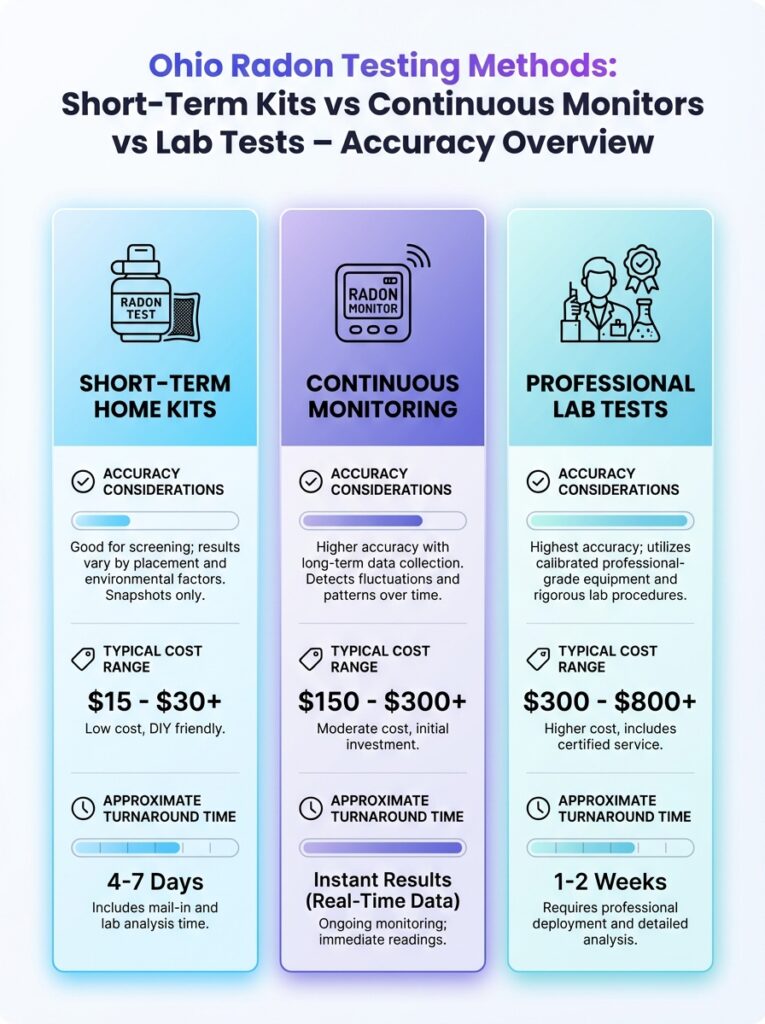
This infographic compares the accuracy of Ohio radon testing methods, highlighting short-term kits, continuous monitors, and lab tests. It helps readers interpret radon test results and choose the right approach.
Continuous monitors also shine in longer tests, because extended exposure time tends to smooth out short spikes and dips. That is one reason we like the Columbus Metropolitan Library’s free monitor loan program for homeowners who want to see how their radon behaves over several days or weeks.
In contrast, charcoal kits are heavily dependent on you following the directions about placement, timing, and mailing, so small handling errors can have a larger impact on your final number.
Did You Know?
Consumer‑grade electronic radon monitors show two performance groups: conforming devices with average differences under 22%, and non‑conforming devices with much larger errors up to 238%.
4. Common Sources of Error in Ohio DIY Radon Test Kits
Even the best‑designed radon test kit can give you a misleading result if it is not used correctly. In Ohio, we regularly see three user‑driven issues that interfere with accurate readings.
First, charcoal kits do not like high humidity or sitting near kitchens, bathrooms, or sump pumps. Second, poor sealing before mailing can let radon escape or air leak in, which changes the measurement from what your home actually experienced.
Third, placement matters more than most people expect. If a kit is left on a windowsill with drafts, in direct sunlight, or right beside a furnace supply register, that location can skew the sample away from the breathing zone of the typical occupant.
For continuous monitors, errors are more likely to come from bumping, unplugging, or moving the device around the house while it is in test mode, rather than from temperature or humidity alone.
5. Ohio Regulations That Support Testing Accuracy
Ohio treats radon testing as a regulated activity for professionals, and that benefits homeowners who want dependable numbers. Licensed radon testers must list their instruments, calibration routines, and quality control procedures with the state.
Any significant changes in their equipment or QA plans require approval from the director, which sets a baseline for how consistently devices are maintained across Ohio. The state also restricts unlicensed individuals from offering radon testing as a service, which is intended to keep low‑quality, unverified devices out of professional use.
For you as a homeowner, those rules mean that a licensed tester is not just bringing a gadget, they are bringing a documented process for keeping that gadget within acceptable accuracy ranges. When we arrive on site, our equipment and methods have already gone through that review.
DIY kits you buy online are not subject to Ohio’s licensing rules, which is why it is important to choose brands that participate in national proficiency programs and to follow their instructions carefully.
6. Interpreting Your Ohio Radon Test Results With Confidence
Once you have a result in hand, the next question is how much trust to put in that single number. We always remind homeowners that radon is a variable gas, so any test, even an accurate one, is a snapshot of conditions during the test window.
Here is a simple way to think about it in Ohio homes:
- Below 2 pCi/L on a correctly run test usually suggests a relatively low level, but periodic re‑testing is still reasonable, especially after renovations.
- Between 2 and 4 pCi/L deserves closer monitoring with another short‑term kit or a longer continuous monitor test, particularly in high‑risk counties.
- At or above 4 pCi/L on repeated tests signals that mitigation is worth serious consideration, even if daily fluctuations mean the number is not identical every time.
When two different methods disagree, such as a charcoal kit and a continuous monitor, we look at duration, seasonal timing, and how closely instructions were followed before deciding which result to lean on.
If you remain unsure, bringing in a licensed Ohio tester for a professionally controlled measurement is often the most direct way to gain clarity.


7. Free and Low‑Cost Radon Test Options In Ohio And Their Reliability
Many Ohio homeowners first encounter radon testing through free programs, library loans, or low‑cost kits handed out during awareness campaigns. These options are designed to lower the barrier to that all‑important first test.
Ohio’s free test kit efforts have reached tens of thousands of households, yet that still represents a small share of all homes in the state. Limited supply sometimes means test kits run out for part of the year, which delays how quickly communities can get a complete picture of local radon patterns.
When you receive a free kit from a public program, you are typically getting a device from a vetted lab that participates in proficiency programs. In our experience, those kits are just as capable as retail options, provided you follow the guidelines on placement, exposure time, and mailing deadlines.
For longer and more detailed tracking, public continuous monitor loans such as the Columbus Metropolitan Library program give residents lab‑grade monitoring without lab fees, which is a strong combination of accessibility and accuracy.
Did You Know?
The U.S. EPA states that radon measurements are accurate and reliable when devices are used properly, which supports Ohio homeowners who choose DIY radon testing and follow instructions carefully.
8. Professional Radon Testing In Ohio: When Extra Accuracy Is Worth It
DIY kits are an excellent starting point, but there are situations where the extra controls of a professional test in Ohio are very helpful. Home sales, complex foundations, and very high preliminary readings are common examples.
We use calibrated continuous monitors, controlled protocols, and tamper checks to reduce as many variables as possible. For sellers and buyers, that process creates results that both sides can rely on when deciding whether to request or offer mitigation.
In homes with mixed foundations or large square footage, multiple test locations may be necessary for an accurate picture. A professional can design that test plan so that all the key occupied areas are represented in the final assessment.
Our own approach in central Ohio is to treat professional testing as a complement to homeowner kits, not a replacement, so residents stay informed between real estate transactions and after major remodeling.


9. From Accurate Test To Effective Mitigation In Ohio Homes
Once accurate testing shows that your Ohio home has consistently elevated radon, your focus shifts from measurement to reduction. The same attention to detail that improves test accuracy also applies to designing and installing a reliable mitigation system.
In central Ohio, typical active soil depressurization systems often fall in the $1,200 to $2,500 range, depending on home size, foundation type, and how many suction points are needed. Basement‑only systems are usually at the lower end, with crawl spaces and multi‑foundation homes at the higher end.
Post‑mitigation testing is a critical accuracy checkpoint. We always recommend a follow‑up test after installation, using either a professional continuous monitor or a well‑run kit, to confirm that the system is keeping levels in the target range.
Over time, periodic re‑testing, even with DIY kits, helps verify that the system continues to perform as your home ages and as seasonal conditions change.

10. Practical Checklist: Getting The Most Accurate Radon Reading In Your Ohio Home
To wrap up the accuracy conversation in a practical way, here is a quick checklist we share with Ohio homeowners before they start testing. Following these steps goes a long way toward getting a result you can trust.
- Choose a kit or monitor from a recognized brand or program that participates in national proficiency testing.
- Test the lowest level of the home that is regularly used, such as a finished or frequently occupied basement.
- Keep windows and exterior doors closed as much as practical during the test period, except for normal entry and exit.
- Place the device 2 to 6 feet above the floor, away from drafts, direct sunlight, high humidity areas, and exterior walls.
- Do not move or disturb the device during the test period.
- For charcoal kits, seal and mail the kit to the lab immediately when the test period ends.
- Repeat testing in another season or with a different method if your result is near your decision threshold.
Used thoughtfully, both DIY kits and professional testing can provide the accuracy Ohio families need to make informed decisions about mitigation.

Conclusion
Ohio radon test kit accuracy is not about perfection, it is about getting a clear enough picture to guide sensible action in a state where many homes sit in high‑risk zones. When homeowners use kits and monitors correctly, and when professionals follow Ohio’s quality requirements, radon measurements can be both dependable and practical for everyday decisions.
If you have already tested and have questions about how much to trust your number, or if you are planning your first test, we are here to walk you through the options, explain what the results really mean for an Ohio home, and help you plan next steps that fit your comfort level and budget.