Winter radon levels in Columbus can run significantly higher than in other seasons, with research showing cold‑weather readings often 20 to 40 percent greater due to closed-up homes and powerful stack effects that pull radon in from the soil.
Key Takeaways
| Question | Short Answer |
|---|---|
| Are winter radon levels higher in Columbus homes? | Yes, winter usually brings the highest indoor radon readings in Central Ohio, so cold‑season testing is strongly recommended. |
| How risky is Columbus compared to other cities? | Columbus sits in EPA Radon Zone 1 and averages over 8.0 pCi/L in many tests, which is above the EPA action level of 4.0 pCi/L, as we explain on our Columbus radon zones guide. |
| When is the best time to test for radon in Columbus? | January and February are ideal because windows are closed and heating systems run more often, which reveals true winter radon levels as highlighted in our Columbus Radon Awareness Week resource. |
| Can I test my Columbus home for radon at low or no cost in winter? | Yes, you can borrow a continuous monitor free from the library, using our step‑by‑step Columbus library radon testing guide. |
| What if my winter test comes back high? | Most Columbus mitigation systems range from $800 to $2,500, which we break down by home type in our detailed radon mitigation cost breakdown for Columbus. |
| Can higher‑end homes in suburbs avoid winter radon problems? | No, luxury and wealthy neighborhoods also show elevated winter radon, as we discuss in our Columbus wealthy neighborhoods radon overview. |
1. Why Winter Radon Levels Rise Across Columbus
In winter, Columbus homes are sealed tight against the cold, which sharply reduces natural ventilation and lets radon accumulate indoors.
Heating systems also create a stack effect that pulls soil gases into basements and lower levels, which often leads to higher radon readings than in milder seasons.
How Cold Weather Changes Your Home’s Airflow
Warm indoor air rises and escapes through your attic and upper floors, which pulls replacement air from the lowest parts of the home.
Cracks in slabs, sump pits, and gaps around utility lines become entry points in winter, feeding radon into basements and crawl spaces.
Columbus Soil and Radon Zone 1 in Winter
Columbus sits on uranium‑rich shale and clay soils that naturally generate more radon, and winter conditions simply trap more of that gas inside.
Because Franklin County is in EPA Radon Zone 1, we expect more homes to cross the 4.0 pCi/L action level when we test during December through February.
2. Columbus Radon Numbers: How Winter Readings Compare
Ohio’s average indoor radon level is around 7.8 pCi/L, which is several times higher than the typical U.S. indoor average of about 1.3 pCi/L.
In Franklin County, private test aggregators report average indoor readings near 6 pCi/L, and winter tests often come back higher than that baseline.
EPA Action Level and What It Means in Winter
The EPA recommends mitigation when a home tests at or above 4.0 pCi/L, and many Columbus basements exceed that during cold months.
Winter results sometimes surprise homeowners whose summer or fall test kits showed lower values, which is why we encourage at least one cold‑season test.
Short‑Term vs Long‑Term Winter Testing
Short‑term tests (2 to 7 days) can quickly confirm if your winter radon level is above the action threshold, which is useful during home sales or renovations.
Long‑term tests (90+ days), especially when started in winter, give a more complete picture that includes multiple heating and mild‑weather cycles.
3. Winter Radon Testing Options For Columbus Homeowners
Columbus residents have several winter testing options, from free do‑it‑yourself kits to professional continuous monitoring.
Our goal is to help you match the right option to your home, budget, and timeline so you can make clear decisions before spring arrives.
Free and Low‑Cost Winter Test Kits
Ohio’s indoor radon program periodically offers free mail‑order kits, which many Columbus homeowners use during January Radon Awareness Month.
Some local campaigns also provide a $0 radon test kit during Columbus Radon Action Month, so winter is often the most affordable time to check your levels.
When to Choose Professional Winter Testing
Professional, NRPP‑certified testing is especially helpful if you need detailed reports for a real estate transaction or are confirming previous high readings.
We typically deploy continuous monitors for 48 to 72 hours in winter, which captures overnight and daytime variations while your heating system runs.
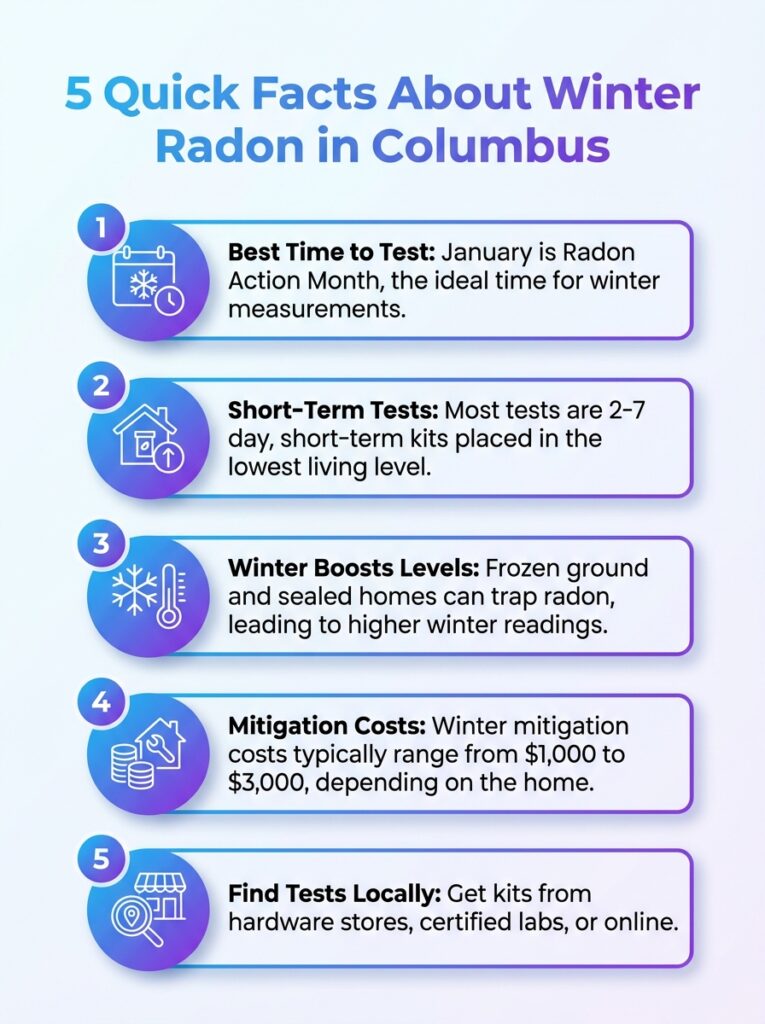
A concise visual guide highlighting 5 quick facts about winter radon in Columbus. Learn how to test and reduce radon indoors.
4. Using the Columbus Library Radon Monitor Program in Winter
The Columbus Metropolitan Library’s winter radon monitor lending program is one of the easiest ways to see real‑time levels in your home.
All branches participate, so most Columbus residents are within a short drive of a free continuous monitor they can borrow for several days.
How the Winter Borrowing Process Works
You reserve a monitor through the library system, pick it up at your local branch, and set it up in your lowest livable level for a few days.
The device logs hourly readings, which helps you see how winter activities like cooking, showering, and running the furnace affect radon levels.
Why Continuous Monitors Are Helpful In Cold Months
Continuous monitors show how nighttime inversions, deep freezes, and snow cover can temporarily push radon spikes even higher than daytime averages.
This data lets us decide whether a mitigation system, additional sealing, or follow‑up testing in another season is the best next step.

Did You Know?
National data show winter months often yield higher indoor radon concentrations across many states, with January and February frequently above EPA action thresholds.
5. Winter Radon Levels In Wealthy Columbus Neighborhoods
High winter radon levels are not limited to older or lower‑priced properties in Columbus, and we routinely see elevated results in Dublin, New Albany, Upper Arlington, and Bexley.
Premium homes often have larger footprints, complex foundations, and extensive basements, which can create more entry points for soil gas in winter.
Geology Beneath Columbus Luxury Homes
Affluent neighborhoods still sit on the same Central Ohio geology that puts so much of Franklin County in Radon Zone 1.
When cold weather locks windows and doors shut, even new luxury builds can show winter radon levels that surprise their owners.
What Upscale Homeowners Should Expect From Winter Testing
We usually recommend at least one winter test on the lowest finished level, followed by a targeted follow‑up if readings come back close to the action threshold.
In many cases we design mitigation systems that preserve curb appeal and fit HOA requirements while still keeping levels low during the coldest months.

6. Winter Radon Mitigation Costs For Columbus Homes
If your winter test shows elevated radon, the next step is to understand what a mitigation system typically costs in Columbus.
Cold‑season installations follow the same pricing structure as summer jobs, but winter weather can influence scheduling and specific routing choices.
Typical Winter System Price Ranges
For most Columbus basements, a single‑point system usually falls between $1,200 and $1,500, depending on layout and discharge location.
Crawl space homes often run $1,500 to $2,200, while large or complex foundations with multiple suction points can reach $2,000 to $3,500.
What Drives Winter Mitigation Pricing
Key cost factors include foundation type, required fan size, length of exterior piping, and how much sealing we must complete to control airflow.
We also account for permitting, post‑mitigation winter testing, and any aesthetic upgrades you request to keep exterior components discreet.
7. Long‑Term Winter Costs: Fans, Power, And Re‑Testing
When you look at winter radon control, it helps to consider the full 10‑year cost of running and maintaining a system, not just the installation day.
Fans run year‑round, but winter is when they often work hardest because of pressure differences and longer furnace runtimes.
Projected 10‑Year Radon Cost Range
In Columbus, the 10‑year total cost of a mitigation system often falls between $2,775 and $6,200, including installation, power, testing, and periodic repairs.
Annual electricity costs for a continuously running radon fan typically land around $60 to $180 depending on your electric rates and fan size.
Why You Should Not Shut Your System Off In Winter
Turning the fan off to save power in winter defeats the purpose of mitigation and usually lets radon levels rise again inside the home.
Instead, we recommend leaving the system on continuously and budgeting for low monthly energy use as part of your winter home operating costs.
Did You Know?
Ohio distributed 71,434 free radon tests from 2016 through October 2025, and by 2021 about 67,668 mitigation systems had been installed statewide, with many tests and installations concentrated in winter.
8. Winter Testing For Columbus Schools And Public Buildings
Winter radon levels matter not only in homes but also in schools, libraries, and workplaces across the Columbus area.
Some Columbus schools and districts have not tested classrooms consistently, so potential winter radon issues in educational spaces may go undetected.
Why Winter Is The Right Time To Test Classrooms
Classrooms are usually occupied with windows closed while heating systems run, which makes winter testing more representative of everyday conditions.
Testing during breaks can still be useful, but occupied winter days show how doors, ventilation schedules, and occupancy affect radon levels.
How Community Testing Efforts Help
Community partnerships, like the Columbus library radon monitor program, help residents understand their own winter radon numbers and advocate for testing in shared spaces.
We encourage PTAs, neighborhood groups, and facility managers to treat winter radon monitoring as a standard part of building safety planning.
9. Negotiating Winter Radon Issues During a Columbus Home Sale
Many Columbus home inspections take place in winter, which means radon tests often capture the highest levels a property will see all year.
When winter results exceed the action level, buyers and sellers must agree on mitigation, price concessions, or additional testing.
Advantages Of Winter Radon Tests In Real Estate
From a buyer’s perspective, a winter test shows how the home performs in a worst‑case scenario with closed windows and strong stack effects.
Sellers can also benefit by testing before listing so they avoid surprises and can present proof of a mitigation system that handles winter conditions.
How Mitigation Quotes Affect Negotiations
Typical Columbus mitigation quotes between $800 and $2,500 provide a concrete number that buyers and sellers can work into purchase agreements.
Agreements sometimes include winter post‑mitigation testing to verify that the new system holds levels below the target range during cold weather.
10. Practical Winter Radon Checklist For Columbus Residents
To make winter radon management more practical, we like to give Columbus homeowners a simple checklist they can follow each cold season.
This keeps testing, mitigation, and monitoring on a predictable schedule rather than something you only think about when selling a house.
Winter Radon Action Steps
- Schedule or perform at least one radon test between December and February.
- Place the device on the lowest livable level, away from drafts, exterior walls, and heat sources.
- Keep windows and exterior doors closed except for normal entry and exit during the test.
- If results are at or above 4.0 pCi/L, request a professional evaluation and written mitigation quote.
- After installation, complete a winter post‑mitigation test to verify performance.
Monitoring Winter Trends Over Time
We recommend saving each winter’s test report in a home maintenance folder so you can look for patterns year to year.
If levels begin to creep upward again, especially during cold months, it may be time to inspect the system, reseal cracks, or replace an aging fan.
Conclusion
Winter radon levels in Columbus are often the highest of the year, which makes cold‑season testing one of the most important safety steps you can take for your home.
With free library monitors, periodic kit programs, and professional mitigation that typically falls between $800 and $2,500, Columbus homeowners have clear, practical options to measure and reduce radon during the months when it matters most.