If you live in central Ohio, you have probably seen someone joke that their Columbus basement is “spicy” or “radon-flavored,” and there is a serious reason that joke hits home: about 50% of Ohio homes may have a radon problem, yet only a small fraction have mitigation systems installed.
Key Takeaways
| Question | Short Answer |
|---|---|
| What is the “Spicy Basement Columbus Radon Meme” about? | It is a local, tongue‑in‑cheek way to describe how common high radon levels are in Columbus basements, especially in EPA Zone 1 areas explained in our radon zones guide. |
| Why do Columbus basements get called “spicy”? | Because Columbus and Franklin County sit in a high‑risk radon zone, where predicted average levels are above the EPA action threshold, so joking about “spice” is a way to talk about that invisible gas. |
| Is the meme just an online joke? | Not really. It reflects real data from investigations like the one summarized in our Columbus Dispatch radon investigation breakdown, where most tested homes showed elevated levels. |
| What should I do if my basement is “spicy” with radon? | First, test accurately, then review cost and system options like those detailed in our Columbus mitigation cost breakdown. |
| Can I check my basement inexpensively in Columbus? | Yes, you can, including through programs like the library lending monitors, which we explain in our Columbus Metro Library radon testing guide. |
| Where exactly should I place a radon test? | Place it on the lowest livable level in the breathing zone, following placement rules summarized in our room‑by‑room placement article. |
1. How The “Spicy Basement” Columbus Radon Meme Started
The “spicy basement” phrase popped up as Columbus homeowners started blending local humor with growing awareness that central Ohio sits in one of the country’s highest radon risk zones. People wanted a way to talk about an invisible gas that is serious without sounding alarmist in every conversation.
As more Columbus residents saw friends post screenshots of radon monitors reading well above 4.0 pCi/L, “my basement is spicy” became a quick shorthand for “my radon numbers are higher than I expected.” We see this meme as a signal that our community is finally beginning to talk openly about radon.
2. Columbus, EPA Zone 1, And Why Basements Feel Extra “Spicy” Here
Columbus and much of Franklin County fall into EPA Radon Zone 1, which means the predicted average indoor radon level is greater than 4.0 pCi/L, the federal action threshold. In practical terms, that means our region is expected to have more homes with elevated readings than many other parts of the country.
Ohio’s overall average indoor radon level has been reported around 7.8 pCi/L, while the U.S. national average is about 1.3 pCi/L, so central Ohio basements start from a risk profile that is simply higher than normal. When locals change that reality into a meme, they are trying to make sense of a number that feels abstract at first.
3. From Meme To Data: What Local Investigations Revealed
The “spicy basement” joke turned more serious in 2025 when The Columbus Dispatch partnered with public health groups to test 68 homes across the metro area. Nearly 80% of those homes recorded radon levels above the EPA action threshold, which confirmed what many of us in the industry already see in day‑to‑day testing.
Our breakdown of that investigation walks through how ordinary homes, in familiar neighborhoods, registered numbers that surprised their owners, even those who had heard the meme before. What the meme captures is this gap between what people suspect and what testing finally shows in black and white on a monitor screen.
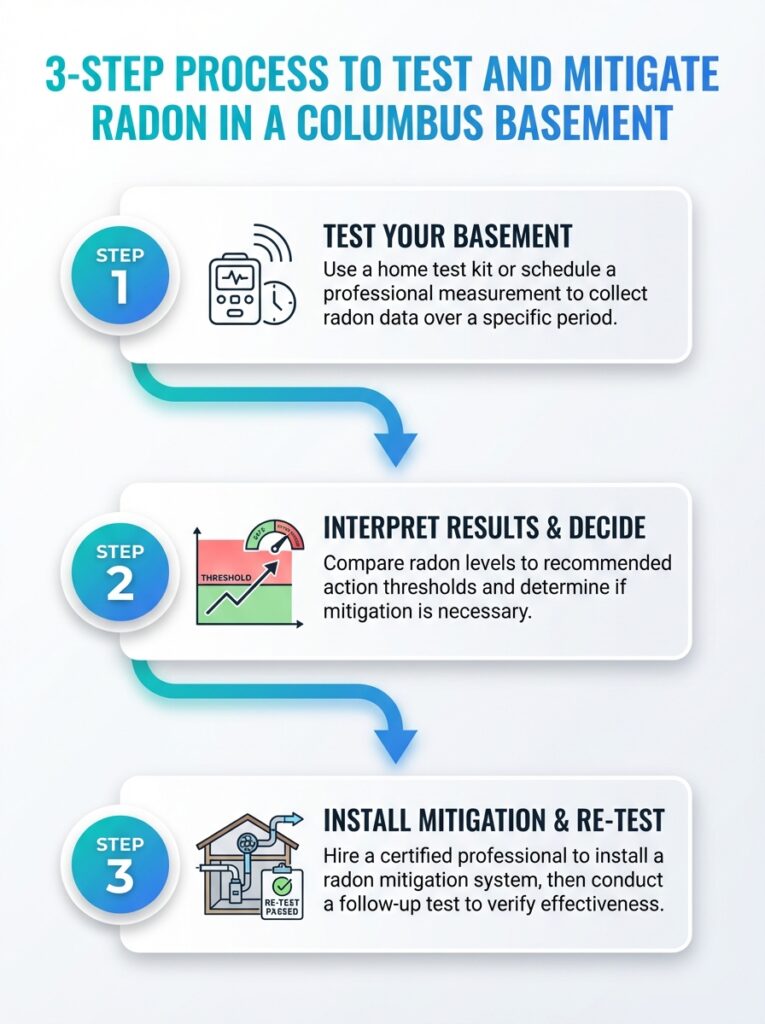
A quick visual guide to testing and reducing radon in a Columbus basement. The meme-inspired design makes the steps easy to follow.
Did You Know?
From 2016 through October 3, 2025, Ohio distributed 71,434 radon tests via free-testing programs, yet millions of homes still have not been checked.
4. Why Humor And Memes Show Up In Serious Radon Conversations
When people first learn that radon is colorless and odorless, it often feels overwhelming, especially when you hear that the EPA recommends fixing homes at 4 pCi/L and considering action even between 2 and 4 pCi/L. Humor, including meme formats, becomes a way to lower the emotional temperature while still keeping the topic visible.
Online, we see jokes about “RADON OVERLORD” or “spicy basements” side by side with screenshots of real‑time radon monitors and mitigation quotes. From our perspective, anything that encourages more conversations, more testing, and more informed decisions is a positive step, as long as people remember that a meme is just the starting point.
5. How “Spicy Basement” Talk Is Changing Testing Habits In Columbus
Even though around 75% of Americans have never tested their home for radon, we are starting to see more Columbus homeowners take that first step, often after seeing a meme or a friend’s radon screenshot. The phrase “I should see how spicy my basement is” regularly turns into an actual test order.
Local programs, especially the Columbus Metropolitan Library’s radon monitor lending initiative, have also helped more residents move from joking online to collecting real data. When testing becomes as simple as checking out a book, it is easier for people to confirm whether their “spicy basement” is just a meme or a measurable issue.
6. What Counts As A “Spicy” Radon Level In A Columbus Basement?
Different people use “spicy” jokingly for different numbers, but we encourage homeowners to ground that talk in the reference points used by national agencies. The U.S. national average indoor radon level is about 1.3 pCi/L, and the EPA recommends taking action at 4.0 pCi/L or higher, while also noting that there is no known completely safe level.
In practice, many Columbus social posts start calling a basement “spicy” around 4 pCi/L, then get more dramatic once numbers climb into double digits. We prefer to look at it this way: any result at or above 4.0 pCi/L deserves clear, calm attention and a step‑by‑step plan, even if the meme language is what drew you into checking in the first place.
7. Turning Meme Energy Into A Simple Testing Plan
We recommend that anyone who has ever joked about a “spicy basement” follow a straightforward three‑step plan: test, confirm, then plan mitigation if needed. First, choose a testing method that fits your budget and schedule, whether that is a short‑term charcoal kit, a continuous electronic monitor, or a professional test.
Second, make sure the device is placed correctly so your results reflect the air people actually breathe. That means putting the test on the lowest livable level, in the breathing zone about 2 to 6 feet above the floor, away from drafts, windows, and exterior doors. Third, if numbers come back at or above action levels, collect a follow‑up test or professional opinion and begin discussing mitigation options.
Did You Know?
In Columbus, radon is considered high risk (EPA Zone 1) with an average indoor radon level around 5.0 pCi/L, which is above the federal action threshold.
8. When A “Spicy Basement” Leads To A Mitigation Quote
Once a homeowner has test results that confirm elevated radon, the next meme‑to‑reality moment often happens when they ask, “How much is this going to cost me?” In Columbus, typical professional mitigation systems usually range from about $1,200 to $2,500, with many standard basement installations falling near the $1,500 mark.
Costs depend on factors such as foundation type, accessible routes for vent piping, fan sizing, and whether a sump pump or crawlspace needs sealing or integration. We encourage homeowners to gather at least two or three quotes, ask about exact components, and make sure any contractor is properly credentialed and experienced with Columbus soil and housing stock.
9. Real‑World Columbus Quotes Behind The Meme
In our review of 25 local mitigation projects, Columbus homeowners reported quotes as low as around $800 for simple, straightforward basement systems, up to roughly $2,500 for more complex situations. The spread often came down to home size, the number of suction points required, and how visible or hidden the exterior vent run needed to be.
Some homeowners have shared their quotes directly in social media threads under radon meme posts, using humor to soften the surprise before they sign a contract. We see clear patterns: homes with finished basements and multiple foundation types tend to sit at the higher end, while uncomplicated basements with easy exterior access land closer to the middle of the range.
10. Meme Culture, Placement Rules, And Doing Testing Right
One detail that often gets lost in jokes is how crucial correct test placement is. Even the best meme or the fanciest continuous monitor will not help much if the device is stuck beside a drafty window or on a stairway where people do not actually spend time.
We advise Columbus homeowners to treat placement guidelines as seriously as they do the number on the screen: test on the lowest level people regularly use, place the device 2 to 6 feet above the floor, keep it at least 3 feet from exterior windows and doors, and leave space around it so air can flow freely. Once you have reliable data, the “spicy basement” meme becomes a conversation starter rather than a distraction.
11. Using “Spicy Basement” As A Nudge To Protect Your Columbus Home
For us as a radon‑focused team, the “Spicy Basement Columbus Radon Meme” is not something to dismiss, it is a reminder that people want to talk about radon in ways that feel real and approachable. If a single meme convinces a neighbor to borrow a monitor or schedule a test, that is a win for the whole community.
We encourage you to keep the humor, but also to follow through with clear steps: test, understand your numbers, and, if needed, plan mitigation that fits your home and budget. When your basement is no longer “spicy” on the monitor, the meme becomes a story about a problem you caught and addressed, instead of a punchline you hope stays hypothetical.
Conclusion
The “Spicy Basement Columbus Radon Meme” grew out of real numbers, local investigations, and a city sitting in EPA Zone 1, where radon is statistically more likely to show up in homes. From our vantage point, it is both a joke and a useful signal that awareness is finally catching up with the data.
If you have ever laughed at a spicy basement post, we encourage you to let that moment push you one step further: schedule a test, follow proper placement rules, and if your results call for it, review mitigation options that fit your home. Turning a meme into measured action is how Columbus basements move from “spicy” to well‑managed, one house at a time.