Across the United States, about 98% of all radon tests are short term and only about 2% are long term, so most homeowners are making decisions based on tests that only capture a snapshot of their radon levels. Understanding the difference between short term and long term radon testing helps you choose the right approach for your home, budget, and timeline.
Key Takeaways
| Question | Answer |
|---|---|
| What is the basic difference between short term and long term radon tests? | Short term tests stay in your home for about 2 to 90 days, while long term tests run for more than 90 days and are better at estimating your year‑round average. |
| When is a short term test enough? | Short term tests are useful for quick screening, real estate deadlines, or during events like Columbus Radon Awareness Week when many homeowners want a fast answer. |
| When should I consider a long term test? | Long term tests are ideal if your short term result is borderline, if you want a more precise picture across seasons, or if you are planning future mitigation or renovation work. |
| What if my short term test is above 4.0 pCi/L? | EPA guidance recommends a follow‑up test, short or long term, to confirm the result before you install a system or negotiate mitigation in a sale. |
| How do test results connect to mitigation costs? | Your confirmed radon level informs the design and scope of a mitigation system, which in Central Ohio usually runs from $800 to $2,500 depending on foundation type and layout, as detailed at this Columbus cost breakdown. |
| Can short term testing work for luxury or complex homes? | Yes, but larger or higher‑value properties often combine multiple short term tests with at least one long term test, a strategy we outline for upscale homes at this high‑value home testing guide. |
| What if mitigation feels expensive right now? | If follow‑up testing confirms a problem, financing options such as in‑house payment plans and third‑party lenders are available, as described in our Columbus radon financing overview. |
Short Term vs Long Term Radon Test: Definitions, Timing, And When To Use Each
We start by defining exactly what short term and long term radon tests are so you can match the method to your goals. The main difference is how long the device sits in your home and how much of the year it captures.
According to federal guidance, short term devices typically remain in place from 2 to 90 days, while long term devices are used for more than 90 days. Longer tests are more likely to reflect your true year‑round average, since they span more weather and lifestyle changes.
Short term tests are often used for:
- Real estate transactions with tight inspection deadlines
- Quick screening in high‑risk areas like Franklin County (EPA Zone 1)
- Follow‑ups after mitigation to confirm system performance over a few days
Long term tests are better suited for:
- Borderline or fluctuating short term results
- Homes with seasonal occupancy, like second homes
- Planning long‑range mitigation or renovation projects
How Short Term Radon Tests Work: Speed, Accuracy, And Best Practices
Short term radon tests are all about speed. We use them when you need initial answers in days instead of months.
Common short term devices include charcoal canisters, electret ion chambers, and continuous radon monitors that log hourly readings. We typically deploy these for 2 to 7 days in real‑world home inspections, even though some devices can run longer within the short term window.
Research shows that a minimum of four days is recommended for initial short term screening to get a reliable signal, and extending the test toward a week or two improves stability. Short term tests are very sensitive to how you live in the home, such as open windows, HVAC settings, and storms during the test week.
For best results, we follow these rules:
- Place the device in the lowest livable level, away from drafts and high heat
- Keep windows closed and exterior doors used only for normal entry and exit
- Avoid placing the device in kitchens, bathrooms, or on exterior walls


How Long Term Radon Tests Work: Year‑Round Picture And Seasonal Effects
Long term radon tests stay in your home for at least 90 days, and often up to a full year. Our goal with long term testing is to even out short‑term swings and capture how your home really behaves across seasons.
Radon levels can change with temperature, stack effect, snow cover, and how much time you spend with windows open. Winter‑month measurements tend to be more representative of annual averages than readings taken in other seasons, because homes are closed up and pressure differences draw more soil gas inside.
Long term devices are usually alpha track detectors or long‑deployment electret chambers. We place them in a central location on the lowest lived‑in level, in an area that will not be disturbed for months.
Practically, we recommend long term tests when:
- A short term test is slightly above or below your action threshold and you want more certainty
- You are not under any real estate deadline and can wait for the clearest possible answer
- You want to verify that mitigation has stabilized radon levels across multiple seasons
Accuracy Comparison: How Much Can You Trust Short Term vs Long Term Results?
Accuracy is the core of the short term vs long term radon test debate. Both methods have strengths, they just answer slightly different questions.
On a national scale, research shows that short term measurements can explain up to 79% of seasonal variance and up to 67% of annual variance in radon concentrations. In other words, a well‑run short term test can give you a solid first picture, but it does not always capture the full year.
One study in Calgary reported that very short tests under 90 days can be imprecise up to 99% of the time compared with long term testing. That does not mean short term tests are useless, it means we should treat them as screening tools, then confirm with follow‑up testing when results are elevated or borderline.
For low radon levels under about 75 Bq/m³ (roughly 2 pCi/L), a one‑week short term test can still provide more than 95% confidence in predicting annual averages according to recent sensor research. So if your initial reading is clearly low, a short term test can be quite reassuring.
| Feature | Short Term Test | Long Term Test |
|---|---|---|
| Typical duration | 2 to 7 days (up to 90 days) | 90 days to 12 months |
| Best use | Screening, real estate deadlines, quick checks | Year‑round average, borderline cases, planning |
| Sensitivity to weather / lifestyle | High | Lower, effects average out |
| Result speed | Fast | Slow |
| Overall reliability for annual average | Good to fair, depends on duration and timing | High |


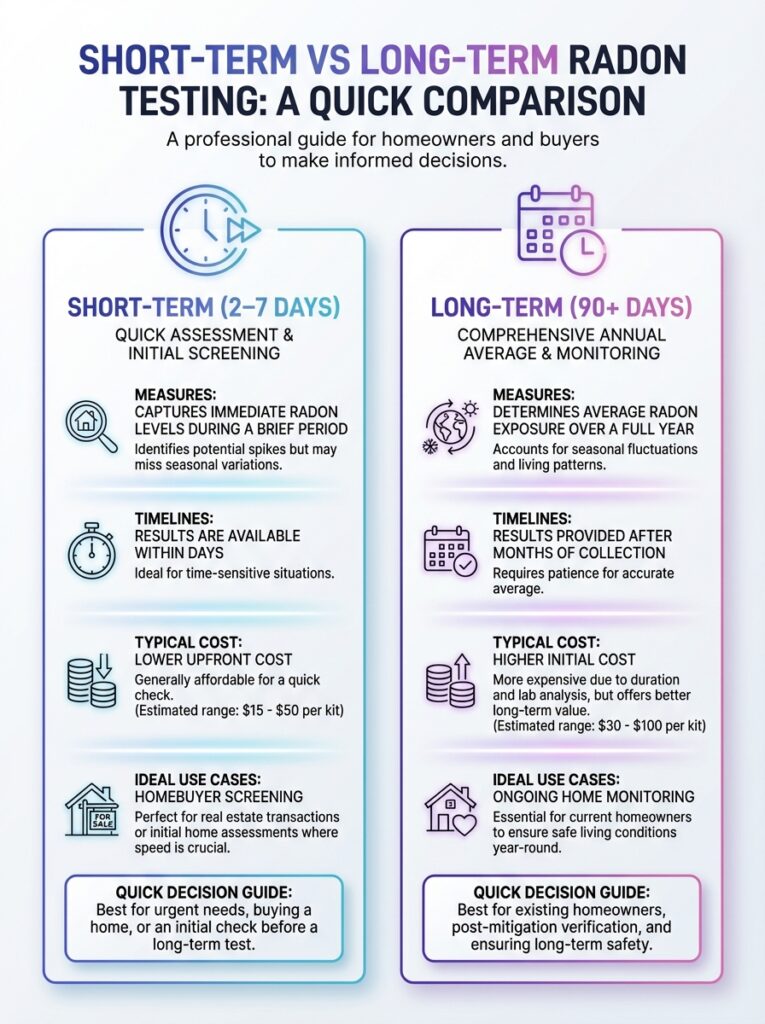
A concise visual guide contrasting short-term and long-term radon testing approaches and what the results imply for safety.
Did You Know?
In the United States, long-term radon testing represents about 2% of all tests, while short-term tests account for about 98%, so nearly all decisions are being made from short sampling windows.
Short Term vs Long Term In Real Estate: Testing During Home Sales
Real estate is where the short term vs long term radon test decision feels most urgent. Buyers and sellers have limited time to act, and radon can suddenly become a negotiation point.
In most Columbus home inspections, short term devices are used for 2 to 7 days because contract timelines rarely allow 90‑day or 12‑month tests. These results drive decisions about repair requests, mitigation credits, or price adjustments.
We regularly see this pattern:
- Short term result clearly low: buyers typically accept the result and move forward
- Short term result moderately high: buyers request mitigation or a credit for a future system
- Short term result very high: buyers may require immediate mitigation as a condition of closing
Where does long term testing fit in a sale? Most often, the long term test happens after closing, as a follow‑up to either verify the seller’s short term result or confirm that a new mitigation system is keeping levels in the desired range over time.

Basement vs Upper Floor Testing: Where You Place The Device Matters
Short term vs long term radon testing decisions are closely tied to where you measure. A basement test does not always predict what you will breathe on upper floors, especially with short term devices.
One large study found that about 60% of short term basement tests were equal to or above the EPA action level, while only about 30% of year‑long upper‑floor tests were at or above that level. The predictive value of a positive basement short term test for year‑long upper‑floor exposure was only about 44%.
Here is how we use that information in practice:
- If you use your basement as living space, we treat basement results as directly relevant to your day‑to‑day exposure.
- If your basement is unfinished storage, we pay special attention to upper‑floor measurements, especially for long term tests.
- We often recommend a second device on a main living level if the basement result is high and the home layout is complex.
Long term testing on the main living level is especially useful in split‑level homes, homes with additions, and properties where the basement is only partially conditioned.
From Test Results To Mitigation: How Short And Long Term Data Affect System Design And Cost
Once you know your radon level, the next question is how aggressively to mitigate and what that will cost. Here, the difference between short term and long term data can change the size and layout of your system.
In Columbus, standard single‑point basement systems usually run between $800 and $1,500, while more complex multi‑area or slab‑on‑grade systems can reach $1,800 to $2,500+. These ranges come from dozens of real homeowner quotes collected across Central Ohio.
We approach it this way:
- Very high short term result, especially in winter: we are confident recommending mitigation based on that single test, often using active soil depressurization with a dedicated radon fan.
- Borderline short term result: we usually suggest a long term follow‑up to confirm levels before finalizing system scope.
- After mitigation: we perform short term post‑tests, then optionally add long term monitoring to confirm stable performance.
Remember that the lifetime cost of mitigation also includes electricity, periodic testing, and occasional repairs. Over 10 years, that total can land between about $2,775 and $6,200 when you add installation, operation, and maintenance together.

Did You Know?
A minimum of four days is recommended for initial short-term screening to get a reliable signal, and extending short-term tests closer to a week or more significantly improves accuracy.
Choosing The Right Strategy: When To Use Short Term, Long Term, Or Both
We often combine short term and long term radon testing instead of choosing one or the other. The best mix depends on your situation, your risk tolerance, and your timeline.
Here are practical scenarios and the strategies we recommend:
- New homeowner in a high‑risk county with no previous test
Start with a professional short term test in winter if possible, then follow with a long term test if the result is close to your chosen action level. - Selling your home in the spring
Use an NRPP‑certified short term test to meet buyer expectations and inspection timelines. Offer to share results and discuss a mitigation credit if needed. - Levels well above common action thresholds
Confirm with a second short term or an initial long term test, then plan mitigation without delay. Long term post‑mitigation monitoring is a good next step. - Luxury or complex home
Consider multiple short term devices plus at least one long term test to understand variations between wings, additions, and levels.
EPA and state guidance often recommends follow‑up testing whenever an initial short term result is elevated or uncertain. Two short term tests, or one short plus one long term test, give a much clearer signal than a single device alone.


Costs Of Testing: Professional Monitors vs DIY Kits Over Time
Short term vs long term radon testing is not only about science, it is also about cost and convenience. We help homeowners weigh the cost of one professional test against a mix of DIY kits over several years.
Professional NRPP‑certified short term testing with continuous radon monitors provides hour‑by‑hour data and clear reports for real estate and long‑term records. DIY charcoal kits cost less but usually provide only one average value for the test period.
Over time, many families use a pattern like this:
- Professional short term test as a baseline
- DIY long term device or subscription monitor for ongoing checks
- Fresh short term tests during key events like renovations, room additions, or changes in HVAC systems
When we look at the full 10‑year picture, the cost of periodic testing is small compared to the installation and operation of a mitigation system. Investing in both short term and long term testing where appropriate gives you better data for the same mitigation dollars.


Working With Certified Radon Professionals For Testing And Mitigation
Whether you choose short term testing, long term testing, or both, working with certified professionals ensures the process is handled correctly from device placement to interpreting results. Our team uses NRPP‑certified equipment and follows national protocols for both measurement and mitigation.
When we design mitigation systems, we use your testing history to choose between approaches like active soil depressurization, crawl space sub‑membrane depressurization, and mixed‑foundation venting. Short term and long term data together help us avoid over‑ or under‑building your system.
Many homeowners also appreciate that we offer:
- Detailed written reports suitable for real estate files and future buyers
- Post‑mitigation testing to document system performance
- Clear estimates in the $800 to $2,500 range with explanation of labor, materials, and warranties
If you are considering testing for the first time, we usually recommend starting with a professional short term test, then planning any long term follow‑up once you see the initial numbers.


Conclusion
Short term vs long term radon testing is not an either‑or decision. Short term tests give you speed and convenience, especially for home sales and first‑time screening, while long term tests provide a clearer view of your year‑round average.
Our approach is simple: use a high‑quality short term test to get the first answer, then deploy long term testing whenever the result is borderline, surprising, or critical for long‑range decisions about mitigation and renovation. With both tools used correctly, you can make confident, informed choices about your home and your budget.