Selling a home in Columbus with high radon can feel stressful, especially once you learn that the average indoor radon level in Ohio is about 7.8 pCi/L, nearly double the EPA action level. We help Columbus sellers navigate testing, mitigation, and negotiations so a radon issue becomes a solvable project instead of a deal breaker.
Key Takeaways
| Question | Short Answer |
|---|---|
| Do I have to disclose radon when selling in Columbus? | Yes, Ohio’s Residential Property Disclosure Form requires you to disclose known radon issues, but you are not required by law to test or fix it before selling. Learn how that plays into negotiations in our guide on negotiating radon during a home sale. |
| How bad is radon in Columbus really? | Columbus sits in EPA Radon Zone 1, which is the highest potential zone for elevated indoor radon, so buyers expect testing. See how local data shapes expectations in the Columbus Dispatch radon investigation breakdown. |
| What does radon mitigation usually cost here? | Typical Columbus systems run about $800 to $1,500 for a straightforward basement and up to $2,500+ for complex foundations. We share real quotes from 25 homeowners in our 2025 Columbus radon cost guide. |
| Will foundation type change my cost? | Yes. Basement, crawl space, and slab homes see different price ranges, from roughly $1,200 for simple basements up to $3,500 for hybrid foundations. Compare scenarios in our foundation-type cost breakdown. |
| Are there hidden costs to budget before listing? | Permits, extensive sealing, and post-mitigation testing can all add to the final bill, so it is smart to plan for them. We outline these line items in our article on hidden radon mitigation costs in Columbus. |
| Can I spread payments out instead of paying all at closing? | Yes, some local pros and lenders offer 0% APR promo financing and flexible plans so you can pay over time. Explore options in our Columbus radon mitigation financing guide. |
| Is DIY testing enough for a Columbus real estate deal? | Most buyers and agents prefer state-licensed testing, especially in real estate transactions, but you can use free monitors first to understand your baseline. The Columbus Library radon monitor program is a great starting point. |
1. Why Radon Matters When You Sell a House in Columbus
Radon is a colorless, odorless gas that comes from the soil and seeps into homes, and in Central Ohio it shows up in many basements and living spaces. When you are selling, buyers and their agents will almost always ask about radon, especially because the Columbus area is known for elevated levels.
Ohio’s average indoor radon level is about 7.8 pCi/L, so local buyers are used to seeing radon tests in inspection contingencies. The EPA action level is 4 pCi/L, and tests at or above this number typically trigger mitigation discussions in a Columbus purchase contract.
- Most home inspectors in Columbus recommend a radon test as part of the standard inspection package.
- Radon results can lead to repair requests, price credits, or seller-paid mitigation before closing.
Understanding this context helps you stay calm and build a clear, realistic plan instead of being surprised halfway through escrow.
2. Ohio Disclosure Rules: What Columbus Home Sellers Must Share
When you list your Columbus home, Ohio requires you to complete a Residential Property Disclosure Form that includes radon. You must disclose if you know about radon testing or mitigation in the home, but state law does not force you to test or fix radon before selling.
This means you have options.
- Option 1: Test and mitigate before listing, then market your home as “radon addressed”.
- Option 2: Disclose what you know, skip pre-listing work, and handle radon as part of negotiations after the buyer’s inspection.
Because Columbus is an EPA Zone 1 area, most buyers expect to see a recent radon test and often prefer a professional system in place. Having a plan before you hit the market helps you avoid rushed decisions later on.
3. Testing Before You List: Smart Move or Waste of Money?
From our experience working with Columbus sellers, pre-listing radon testing is often worth it, especially if your home has a basement or crawl space. Knowing your numbers before buyers walk through the door lets you set expectations with your agent and price the home more confidently.
You have multiple ways to test.
- Free monitors: The Columbus Metropolitan Library program lets you borrow continuous radon monitors at $0 cost, which is a useful first step for curious sellers.
- Professional tests: For real estate, most buyers prefer testing by a state-licensed pro who follows EPA protocols and provides a formal report.
If your pre-listing test shows results below 4 pCi/L, you can share the report and often avoid major radon negotiations. If it shows higher levels, you have time to choose between mitigation, credits, or a price strategy that accounts for buyer requests.
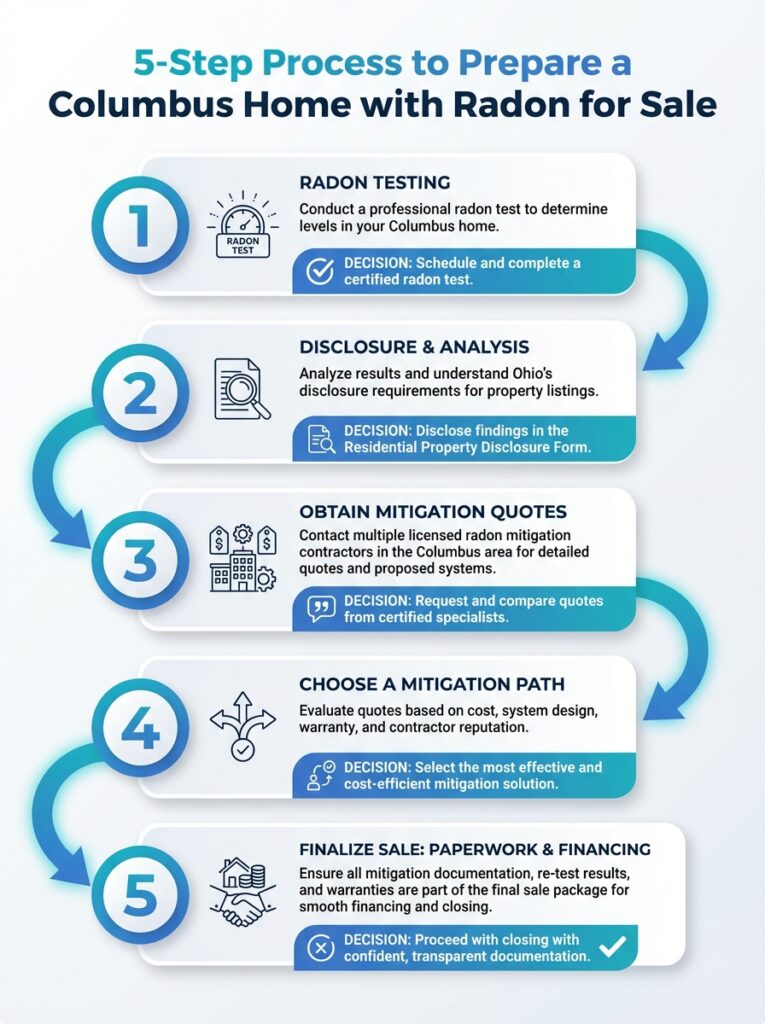
A concise visual guide outlining the 5 steps to ready a Columbus home with radon for sale.
4. Understanding Columbus Radon Zones and Buyer Expectations
Columbus sits in EPA Radon Zone 1, which is the highest potential category for elevated indoor radon. That label, combined with local media coverage and library programs, has made radon a routine part of real estate conversations across Franklin County and nearby suburbs.
Buyers in neighborhoods from Clintonville and Westerville to Grove City increasingly expect two things.
- Recent radon test data, ideally from a licensed tester during inspection.
- A clear plan, either a functioning mitigation system or agreement on how mitigation will be handled before or after closing.
Having your own radon information upfront lets you lead the conversation instead of reacting. You can say, “We tested, here are the results, and here is what we are prepared to do,” which builds trust and keeps the deal moving.
Did You Know?
Columbus area sits in EPA Radon Zone 1, the highest potential category for elevated indoor radon, which is why radon tests and mitigation requests are so common in local home sales.
5. How Much Does Radon Mitigation Cost in Columbus Before a Sale?
Cost is usually the first question sellers ask us after they see a high radon test. In Columbus, typical radon mitigation systems for a standard basement home often fall between $800 and $1,500 for a single suction point system.
More complex homes, such as those with large footprints, multiple foundation types, or high initial radon levels, can land in the $1,800 to $2,500+ range.
| Scenario | Typical Columbus Range |
|---|---|
| Simple basement, single suction point | $800 – $1,500 |
| Basement with more complex routing or second suction point | $1,200 – $1,800 |
| Crawl space or hybrid foundations | $1,500 – $2,500+ |
These numbers line up with national averages, which typically run about $1,000 to $2,500. For sellers, this range helps you decide whether to offer a credit at closing, pay for a system upfront, or negotiate based on multiple bids.
6. Foundation Type: How Basements, Crawl Spaces, and Slabs Change Your Budget
Your foundation type in Columbus is one of the biggest factors in your radon mitigation cost. A straightforward basement or slab-on-grade system is typically the least expensive, while crawl spaces and hybrid foundations often require more extensive work.
From local cost breakdowns, here is what we usually see.
- Basement / slab: around $1,200 to $1,800 depending on size and complexity.
- Crawl space: often $1,500 to $2,500, especially if encapsulation or extra sealing is included.
- Multiple / hybrid foundations: can reach $2,000 to $3,500 when multiple suction points and longer piping runs are needed.
For sellers, understanding this ahead of time lets you decide if you want a full system installed before listing or if you prefer to negotiate a credit that reflects the more complex work a buyer may need.
7. Hidden Costs Sellers Should Plan For: Permits, Sealing, and Post-Testing
When you budget for mitigation before selling, it is important to think beyond the base system price. In Columbus, total project cost can include building permits, extensive crack sealing, and at least one round of post-mitigation testing to confirm results.
Typical add-ons sellers encounter include.
- Permits: Jurisdictions may require a mechanical or building permit, which adds a line item and sometimes a few days of lead time.
- Sealing and prep: Larger or older basements may need more time spent sealing floor cracks, sump lids, and penetrations.
- Post-mitigation test: Even if the buyer will test later, having your own post-test provides documentation to share with them.
Planning for these details helps avoid surprises when you are already under contract and on a tight closing timeline.
8. Negotiating High Radon During Inspection: Credits vs Repairs
If you choose not to mitigate before listing and the buyer’s inspection reveals high radon, you will almost certainly see a radon-related request in their repair addendum. At that point, you and your agent have several common paths.
- Seller installs system before closing: You hire a licensed mitigator, pay the invoice, and provide documentation plus post-mitigation test results.
- Seller gives credit at closing: You offer a dollar amount, often $1,000 to $2,000, so the buyer can install a system with their preferred contractor.
- Price reduction: Instead of a formal credit, you reduce the purchase price to offset the projected mitigation cost.
We encourage sellers to gather at least one or two written estimates quickly so negotiation numbers feel grounded instead of arbitrary. Many Columbus buyers are satisfied if they see that the credit or price change matches realistic local quotes.
Did You Know?
Radon mitigation, when properly designed and installed, can reduce radon levels by up to 99%, which is a strong reassurance point during buyer–seller negotiations.
9. Using Financing and Timing to Keep Your Columbus Sale on Track
Sometimes sellers want to install mitigation but worry about paying the full invoice before they receive sale proceeds. In those cases, financing can bridge the gap so you do not have to choose between cash flow and a smoother transaction.
Many radon contractors and partner lenders offer options like 0% APR promotional periods or fixed low-interest plans specifically for mitigation projects. This lets you spread a $1,500 system over several months while still presenting buyers with a fully installed solution and clean post-mitigation test results.
If you prefer to handle radon after you move out, you and the buyer can agree that funds from closing will be held in escrow for a post-closing installation. That approach takes coordination between your agent, the buyer, and your title company, but it is common in higher-demand parts of Columbus where buyers want to close quickly.
10. Marketing a Columbus Home After Radon Mitigation
If you decide to mitigate before listing, we recommend leaning into that work in your marketing. Many Columbus buyers see a professionally installed, permitted radon system as a plus, similar to having a newer roof or updated mechanicals.
Practical ways to highlight your radon work include.
- Adding “Radon system installed, tested below 4 pCi/L” to your MLS remarks once you have post-mitigation results.
- Leaving the radon test report and system warranty information on the kitchen counter for showings.
- Having your agent mention the system during showings in older neighborhoods where radon awareness is high.
In some cases, that reassurance can set your listing apart from comparable homes that have unknown radon status, which helps buyers feel more confident writing strong offers.
Conclusion
Selling a house with high radon in Columbus does not have to derail your plans or your timeline. With clear disclosure, solid testing, and realistic cost expectations, radon becomes one more repair item you and the buyer can handle with numbers instead of emotion.
Whether you decide to test and mitigate before listing, offer a buyer credit, or combine escrow and financing solutions, the goal is the same. You protect your interests, give buyers confidence in the home, and keep your Columbus sale moving steadily toward a successful closing.