About 50% of Ohio homes have radon levels above the EPA action level of 4 pCi/L, so it is very common for a radon contingency to come up in an Ohio real estate contract.
Key Takeaways
| Question | Answer |
|---|---|
| What is a radon contingency in Ohio? | It is a clause in a purchase contract that allows the buyer to test for radon and request repairs, a mitigation system, or credits if levels exceed an agreed threshold, often based on guidance like we share on our radon negotiation guide. |
| How much does mitigation usually cost in Ohio? | In Columbus and much of Ohio, a professional mitigation system typically ranges from $800 to $2,500, with around $1,200 being common, as outlined in our detailed radon mitigation cost breakdown. |
| Who usually pays for radon mitigation in an Ohio home sale? | Responsibility is negotiable, but many buyers request the seller pay for mitigation or provide a closing credit, which we discuss in our article on how costs are structured. |
| Can I rely on a free or DIY test for a contingency? | Free charcoal kits are a useful screening tool, but real estate contingencies often specify professional, continuous monitoring, which we compare in our guide on Ohio radon test kit accuracy. |
| Do Ohio sellers have to disclose radon? | Ohio law requires sellers to disclose known radon test results on the Residential Property Disclosure Form, a key point when you structure a contingency, as covered in our overview of radon investigations in Ohio homes. |
| Is winter a good time to test for a radon contingency? | Yes, levels often peak in winter in Central Ohio, something we explain in our winter radon testing guide, so winter tests often give a strong picture of worst‑case levels. |
Understanding What a Radon Contingency Means in Ohio
When buyers and sellers in Ohio hear “radon contingency,” they are really talking about how to handle a very common environmental issue without derailing a sale.
In practice, a radon contingency is a written agreement that spells out who tests, what happens if levels are high, and how mitigation or credits will be handled.
Why Radon Contingencies Are So Common In Ohio
Central and southern Ohio sit in areas where elevated radon is routine, so both agents and lenders increasingly expect radon to be addressed in contracts.
Because the average indoor radon level in Ohio is about 7.8–7.9 pCi/L, roughly double the national average, most buyers want a clear plan before finalizing a purchase.
Basic Elements Of An Ohio Radon Contingency
- Deadline for the buyer to order and complete testing.
- The type of test allowed, often a professional short-term test.
- The action level that triggers repairs or negotiation, usually 4.0 pCi/L.
- Options if results are high, such as mitigation, credits, or contract termination.
Why We Recommend Clarity Up Front
We encourage buyers and sellers to be very specific in the contingency so there are no surprises when test results arrive.
Clear language reduces conflict and keeps the focus on practical solutions that keep the transaction moving.
Ohio Laws, Disclosures, and Licensing That Affect Your Contingency
Ohio has specific rules that shape how radon shows up in a real estate transaction, even before you write a contingency.
Understanding these requirements helps you know what to ask for as a buyer and what you must share as a seller.
Radon Disclosure Requirements In Ohio
Ohio law requires sellers to disclose prior radon testing results on the Residential Property Disclosure Form if they know them.
If a seller has never tested, they typically indicate that testing is “unknown,” which is exactly why many buyers insist on a radon contingency.
Licensed Professionals And Why That Matters
Ohio requires licensing for radon testing and mitigation professionals, which gives buyers and sellers confidence in the numbers and the work.
As a licensed provider, we adhere to state protocols so that your contingency relies on trusted data and properly installed systems.
How Disclosures And Licensing Shape Negotiations
When prior results are documented, they often serve as a baseline for new tests or for deciding whether retesting is needed.
Using licensed testers and installers helps both sides feel comfortable accepting results and mitigation as final.
How Radon Testing Works During an Ohio Home Inspection
Most radon contingencies in Ohio tie testing to the standard home inspection window, often 7 to 15 days after contract acceptance.
During that period, buyers schedule a licensed radon test so they can act before inspection deadlines expire.
Professional Short‑Term vs Long‑Term Tests In Transactions
Short‑term tests, typically running 48 to 96 hours, are the most common option in real estate because they fit contract timelines.
Long‑term tests capture seasonal patterns over 90 days or more, but they are less practical for time‑sensitive contingencies.
Placement And Conditions For Valid Results
We follow EPA‑style guidance by placing monitors on the lowest livable level, usually 2 to 6 feet above the floor and away from drafts or exterior doors.
Windows and exterior doors remain closed except for normal entry and exit to keep conditions stable during the test.
What Buyers And Sellers Receive From A Test
At the end of the test, both parties receive a written report that shows hourly or average levels and any notes about conditions.
This report becomes the basis for any repair requests or credits under the contingency terms.
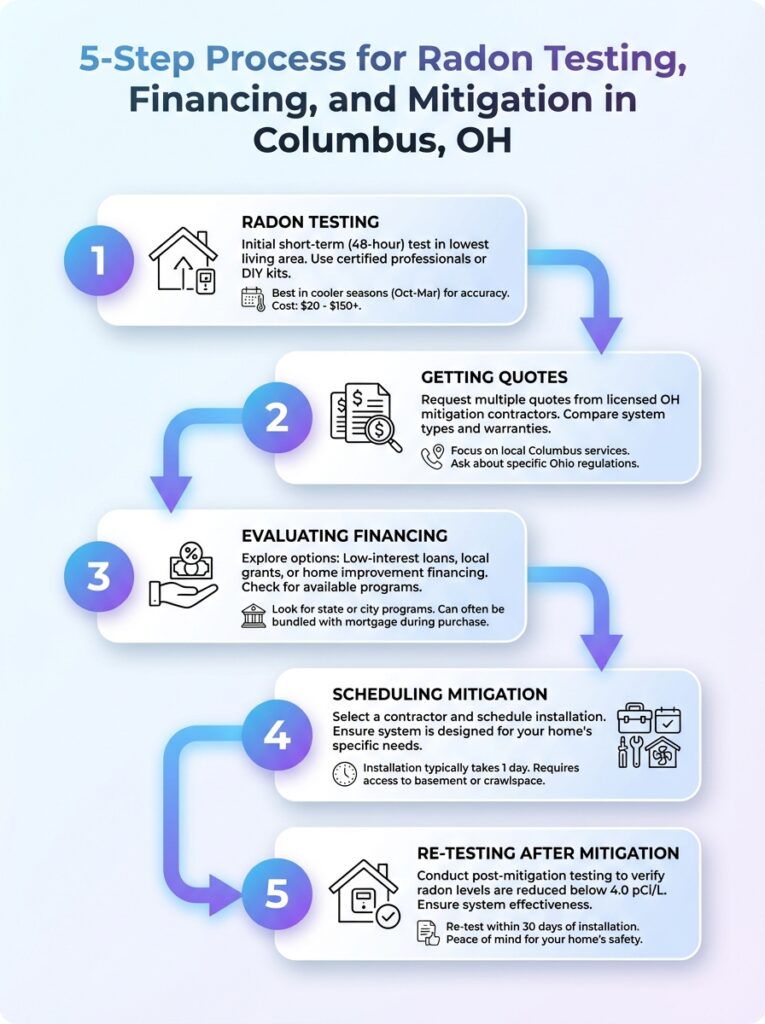
A step-by-step visual guide to testing, financing, and mitigating radon in Columbus, OH.
Did You Know?
In a central Ohio radon testing wave, 54 of 68 homes tested (79.4%) were above the EPA threshold of 4 pCi/L, which is why radon contingencies are becoming standard in many Ohio purchase contracts.
What Counts as “High” Radon in an Ohio Contingency?
Most Ohio contracts use 4.0 pCi/L as the trigger level, since this is the EPA action guideline that agents and inspectors are familiar with.
Some buyers, especially those aware of local hotspots, ask for a lower threshold such as 2.0 or 3.0 pCi/L, but that usually requires more negotiation.
Understanding Local Averages And Hotspots
Some Ohio counties report average radon levels as high as 16 pCi/L, which makes elevated results unsurprising in certain neighborhoods.
In those areas, buyers often plan for mitigation from the start and focus contingency language on how, not whether, mitigation will be completed.
Example Threshold Language
Many contracts say something like “If test results are at or above 4.0 pCi/L, buyer may request seller install a mitigation system or provide a closing credit.”
We recommend clearly stating the test method, the level, and the options both sides have once results come in.
How Averages Compare To Your Specific Home
State and county averages help set expectations, but every home is unique due to soil patterns, construction details, and ventilation habits.
This is why lenders, agents, and our team always come back to actual test data for the property under contract.

Who Pays For Radon Mitigation Under an Ohio Contingency?
Ohio law does not mandate who pays for mitigation, so it all comes down to contract language and negotiation strength.
In our experience, the most common outcomes are either seller‑paid mitigation before closing or a seller credit toward buyer‑installed mitigation.
Typical Cost Ranges For Negotiation
Professional radon mitigation in Columbus typically costs between $800 and $2,500, with most homeowners paying around $1,200 for a complete installation.
This gives both sides a realistic dollar range when discussing credits or repair limits in a contingency.
Common Cost‑Sharing Approaches
- Seller pays full cost for an installed system before closing.
- Seller provides a fixed credit, for example $1,200, and buyer chooses the contractor after closing.
- Buyer accepts the property as‑is in exchange for a lower purchase price.
Why Some Buyers Prefer Credits Over Seller‑Installed Systems
Credits allow buyers to choose their own contractor, system design, and fan quality after closing, which some prefer for long‑term reliability.
Others would rather have everything done before move‑in, so they push for a completed system instead of a credit.
Financing Options When Radon Contingency Repairs Strain Your Budget
Sometimes a radon contingency reveals the need for mitigation at the same time you are juggling down payments and closing costs.
In those cases, financing or structured credits can make repairs more manageable for both sides.
0% APR And Low‑Interest Plans
We often help buyers and sellers explore financing that offers 0% APR for 6–12 months or low‑interest installment plans for mitigation work.
This lets a seller agree to install a system before closing without needing to pay the entire amount out of pocket at once.
Using Credits To Offset Your Out‑Of‑Pocket Cost
Even if buyers ultimately arrange financing, a strong contingency can still secure meaningful seller credits at the closing table.
We recommend buyers have a rough quote from a licensed mitigator ready so credit negotiations are anchored in realistic numbers.
Coordinating Timing With Lenders And Title Companies
When mitigation is scheduled around closing dates, we coordinate with agents and title companies so work and funding line up smoothly.
This coordination keeps the sale on track and avoids last‑minute delays due to open radon issues.
Did You Know?
From 2016 through Oct 3, 2025, Ohio distributed 71,434 free radon tests, which is only about 1.4% of roughly 4.9 million households, so many homes entering the market have never been tested before a buyer requests a radon contingency.
Using Free and DIY Testing Around Your Radon Contingency
Free and DIY tests are a big part of Ohio’s radon story, but they play a different role than professional tests in most contingencies.
We view them as useful early screening tools, especially before you list a home or when you begin house‑hunting.
Free State And Library Programs
Ohio’s Indoor Radon Program and local health departments offer free charcoal test kits that homeowners can order and run themselves.
In the Columbus area, public libraries also lend continuous radon monitors, giving residents real‑time readings at no equipment cost.
DIY Limits In Real Estate Contracts
Most formal contingencies specify a professional, third‑party test to avoid disputes over placement, conditions, or user errors.
However, DIY results can guide whether you decide to include a contingency in your offer or test before you even list a property.
Common DIY Testing Mistakes To Avoid
- Placing the test too close to windows, vents, or exterior doors.
- Not following closed‑house conditions during the test period.
- Running a test for the wrong length of time or ignoring instructions.
What To Expect From a Radon Mitigation System After a Contingency
When a contingency results in mitigation, both buyers and sellers want a clear picture of what the installed system includes.
We focus on durable, code‑compliant systems that are easy for new homeowners to understand and maintain.
Typical System Design And Features
Most Ohio homes receive an active soil depressurization system, which uses a fan to pull radon from beneath the foundation and vent it safely outdoors.
Depending on the property, this may involve sub‑slab piping, crawl space encapsulation, or multiple suction points.
Cost And Scope Expectations
While typical installations range from $800 to $2,500, large homes, complex foundations, or aesthetic routing preferences can increase cost.
Contracts sometimes set a maximum repair amount so sellers know the financial scope before agreeing to install a system.
Post‑Mitigation Testing And Documentation
After installation, we perform follow‑up testing to verify that radon levels have dropped below the agreed threshold.
We document system details, fan model, and test results so buyers have a clear record attached to their home purchase.

How To Negotiate Fairly When Radon Shows Up In Your Report
Once radon results arrive, the contingency phase turns into a negotiation phase, and both sides want fairness and clarity.
Our role is to provide clear pricing and installation options so buyers and sellers can focus on aligning expectations.
Buyer Strategies
Buyers typically present the test report and at least one estimate for mitigation, then request either installation or a matching credit.
They may also ask for an extension of inspection timelines if more evaluation is needed.
Seller Strategies
Sellers often get a second quote or consult a trusted local mitigator to confirm that requested credits align with real costs.
Some sellers choose to install a system themselves before closing to preserve their original sale price.
Keeping The Deal Moving
Clear written proposals, realistic cost expectations, and responsive scheduling keep radon from becoming a deal‑breaker.
We coordinate quickly with both parties to propose solutions that respect the contract timeline.
Seasonal Timing and Special Cases in Ohio Radon Contingencies
Because Ohio’s climate changes sharply through the year, timing has a real impact on radon readings and contingency decisions.
We help buyers and sellers interpret results based on season, occupancy, and future renovation plans.
Winter vs Summer Testing In Contracts
Winter tests sometimes capture higher levels due to closed‑house conditions, stack effect, and reduced natural ventilation.
If a test is done in summer with windows frequently open, some buyers request a follow‑up winter test or an extended testing clause.
Vacant Homes And New Construction
Vacant homes can behave differently than occupied ones, so we note conditions in the report and may recommend follow‑up testing after move‑in.
New construction often includes radon‑resistant features, but testing is still essential before closing and after systems have run for a while.
Homes With Planned Renovations
If buyers plan major changes to basements or HVAC systems, they should expect that radon dynamics might change over time.
We sometimes suggest retesting after renovations, even if a contingency test and mitigation already occurred.
Working With Professional Radon Teams During Your Transaction
A strong radon contingency in Ohio works best when a qualified team supports you from testing through any needed mitigation.
Our goal is to provide clear information, fair pricing, and dependable scheduling so you can focus on closing.
Our Testing And Mitigation Services
We offer NRPP‑certified professional radon testing starting at $99, along with free initial assessments valued at $150.
For mitigation, our active soil depressurization systems generally range from $800 to $2,500, depending on foundation type and complexity.
End‑To‑End Transaction Support
From scheduling tests within tight inspection windows to providing written proposals for credits, we are used to real estate timelines.
We coordinate with agents, buyers, sellers, and title companies so radon issues are documented and addressed before closing.
When To Contact Us In The Process
Buyers often contact us as soon as they write a radon contingency so we can reserve testing slots during the inspection period.
Sellers sometimes call before listing to test and, if needed, mitigate early, which can make negotiations smoother later.


Conclusion
Radon contingencies in Ohio are no longer rare extras, they are a practical tool for handling a very common issue in our state’s housing.
With clear contract language, reliable testing, and realistic mitigation plans, buyers and sellers can address radon confidently while keeping their closing on track.
We are here to guide you through every step of that process, from the first test to final documentation of a completed system.