Most homeowners only discover radon during a real estate transaction or routine test, then quickly learn that radon mitigation systems can range from a few hundred to several thousand dollars, with typical systems costing around $1,000 and a price range from $700 to $4,000.
We wrote this guide to help you compare radon company prices confidently, understand what drives quotes up or down, and see how Columbus and Central Ohio pricing stacks up against national averages.
Key Takeaways
| Question | Key Answer |
|---|---|
| What is a fair price for radon mitigation in Columbus? | Most Columbus homeowners pay between $1,200 and $2,500 for professional mitigation, with many standard systems around $1,200–$1,800. See our detailed breakdown at radon system cost by home type. |
| How do real local quotes compare in 2025? | Recent Columbus quotes from 25 homeowners ranged from $800 to $2,500, averaging about $1,200. You can review these real numbers in this cost summary. |
| Which foundation types cost more to mitigate? | Basement systems usually fall in the $1,200–$1,800 range, while crawl space systems often cost more, around $1,500–$2,500. Learn why in our foundation-type cost comparison. |
| Are there hidden radon mitigation costs? | Yes. Over 10 years, electricity, monitoring, and possible fan replacement can bring your total investment to $2,800–$4,200. We break this down in our hidden-costs guide. |
| Can I spread out the cost over time? | Many Columbus providers offer 0% promotional financing and in-house payment plans, turning a $1,200–$2,800 project into manageable monthly payments. See examples in our financing overview. |
| Should radon mitigation be negotiated in a home sale? | In Central Ohio, buyers and sellers often negotiate credits based on quotes in the $800–$2,500 range. Our detailed advice is in this negotiation guide. |
| Is testing accuracy important before spending on mitigation? | Yes, especially in high-potential areas like Central Ohio. We explain how to interpret kit accuracy in our Ohio test kit article. |
1. Radon Mitigation Price Ranges: National vs Columbus Companies
When you compare radon companies, it helps to start with realistic price expectations for both national averages and local Central Ohio quotes.
Across the U.S., radon mitigation systems typically cost around $1,000, with a wide range from $700 to $4,000, depending on home size, foundation, and complexity.
In Columbus, our research shows most homeowners pay between $1,200 and $2,500, with many landing near $1,500 for a standard sub-slab depressurization system.
Real 2025 data from 25 local homeowners shows a working range of $800 to $2,500, with an average installation around $1,200 for typical homes.
| Scope | Typical Price Range | Average Price |
|---|---|---|
| National radon mitigation | $700 – $4,000 | About $1,000 |
| Columbus radon mitigation | $800 – $2,500 | About $1,200–$1,500 |
When you receive a quote far below these ranges, it is worth checking what is included and whether the company is cutting corners.
If you see proposals at the very top of these ranges, you should expect premium features, complex work, or additional services clearly spelled out.
2. What Drives Radon Company Prices Up or Down?
When we compare quotes from different radon companies, we see the same core price drivers across almost every project.
Understanding these variables helps you compare estimates on an apples-to-apples basis instead of just chasing the lowest number.
Key Pricing Factors Across Companies
- Foundation type (basement, crawl space, slab)
- Home size and footprint
- Existing radon level and how low you want it to go
- Number of suction points and complexity of piping
- Fan size and quality
- Permits, sealing, and post-testing included or extra
The EPA notes that costs vary by home size, foundation type, and local labor rates, and we see this reflected in every Central Ohio project we price.
Two homes on the same street can receive very different quotes if one has a simple basement layout and the other has a low height crawl space, multiple additions, or slab sections.
Example: Standard Columbus Price Components
For a typical Columbus basement home priced around $1,800, the rough breakdown might look like this.
Use this structure when you review itemized quotes from different companies:
| Component | Typical Cost Portion |
|---|---|
| Initial assessment and design | $100 – $250 |
| Labor for core installation | $500 – $900 |
| Piping, exterior venting, materials | $300 – $600 |
| Radon fan | $200 – $400 |
| Sealing cracks, sump integration | $150 – $400 |
| Post-install test and documentation | $100 – $250 |
If a quote looks low, check whether it includes sealing, post-install testing, or permits.
If a quote looks high, ask the company to explain the extra scope so you can decide if those additions are truly necessary.
3. Comparing Radon Prices by Foundation Type: Basement vs Crawl Space vs Slab
Foundation type is one of the biggest price differences you will see when comparing quotes between radon companies.
Basements, crawl spaces, and slabs each require different approaches and, in many cases, different budgets.
Typical Company Price Ranges by Foundation in Columbus
From recent Central Ohio projects, we see these common ranges.
Use them as a benchmark when you evaluate proposals:
| Foundation Type | Typical Local Price Range | Why It Costs This Much |
|---|---|---|
| Basement | $1,200 – $1,800 | Standard sub-slab depressurization, usually one suction point |
| Crawl space | $1,500 – $2,500 | Encapsulation and sub-membrane systems, more labor and materials |
| Slab-on-grade | Often similar to basement, but can vary | Access for suction points can increase labor |
| Sump pump integration | $150 – $400 | Sealing lids and using existing pits as suction points |
When a crawl space is low, damp, or difficult to access, we often see companies at the upper end of the price range, sometimes $2,000+.
Basements with simple layouts and existing sump pits can often be handled near the lower end of the range, especially if fewer suction points are required.
Visualizing Regional Cost Patterns
Central Ohio sits in a high radon potential zone, which is why we see such consistent demand across different foundation types.
Most reputable companies in the region design and price systems with these zone maps in mind, since they often indicate stronger soil gas entry potential.
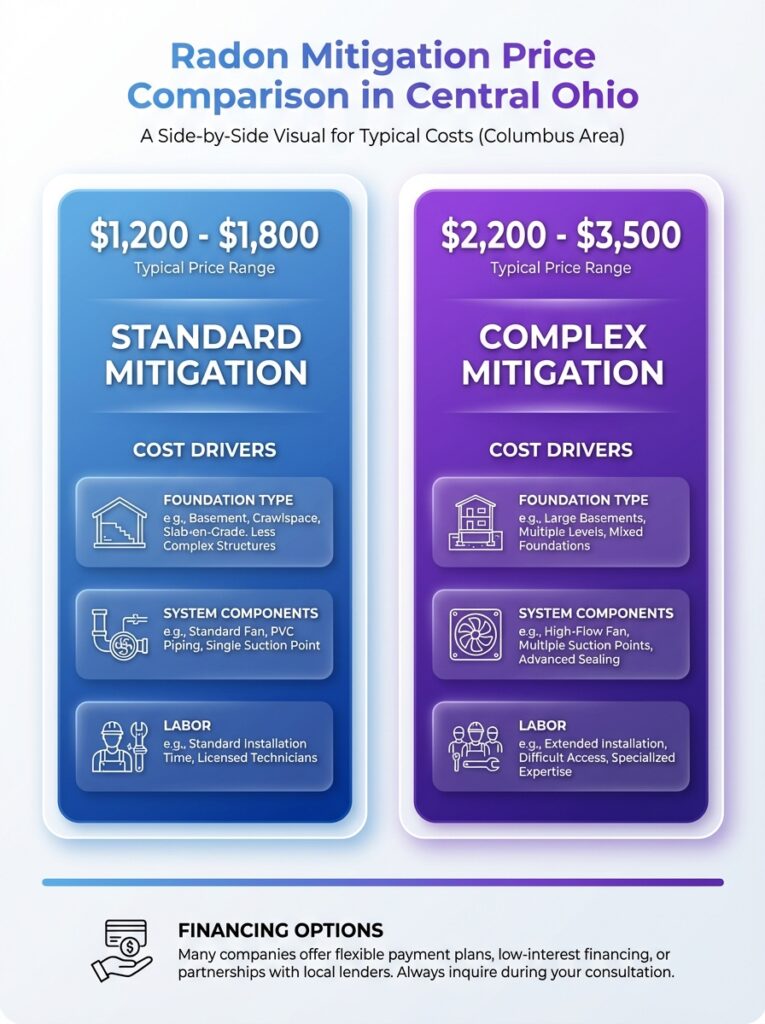
This infographic visualizes radon mitigation price comparisons across Central Ohio providers to help homeowners choose affordable options.
Did You Know?
In 2025, most radon mitigation installations cost between $786 and $1,274, with an average around $1,028, giving you a clear benchmark when comparing local company quotes.
4. Real-World Columbus Quotes: How Different Companies Stack Up
One of the most helpful ways to compare radon companies is to look at what local homeowners actually paid, not just what brochures claim.
From 25 recent Columbus area installations, we see a consistent pattern that you can use as a reference point when you gather your own quotes.
Columbus Radon Price Comparison Snapshot
Below is a simplified view based on those real projects.
Exact companies were anonymized, but the numbers show how bids tend to cluster:
| Type of Home | Low Quote | High Quote | Most Common Price |
|---|---|---|---|
| Small basement home | $800 | $1,600 | About $1,200 |
| Average 2-story with basement | $1,200 | $2,000 | About $1,500 |
| Crawl space home | $1,500 | $2,500 | About $2,000 |
When you compare your own bids, look not only at price but also at the included scope, warranty, and testing.
A quote that is $200 higher may actually be the better value if it includes a longer fan warranty, better sealing, and certified post-install testing.
Using Local Data When Negotiating
If a company quote is far above or below these ranges, ask them to explain the difference in writing.
Clear, detailed proposals are usually a sign that a provider is experienced and transparent about why their price looks the way it does.
5. Hidden Costs Different Radon Companies Handle Differently
Many homeowners focus on the up-front number at the bottom of a quote and forget about long-term costs that can add up over time.
From our experience, the true cost of a radon system over 10 years in Columbus often falls between $2,800 and $4,200 when you include electricity, testing, and maintenance.
Common Hidden Costs to Ask About
- Electricity usage for the fan, running continuously
- Follow-up radon testing every few years or after major changes
- Fan replacement if a unit fails out of warranty
- Sealing touch-ups over time, especially in active basements or crawl spaces
Different companies include or exclude these elements in their proposals, which is why two quotes at the same price may have very different long-term implications.
A provider that helps you budget for long-term ownership often saves you surprises later, even if their initial quote is slightly higher.
10-Year Radon System Cost Example
Below is an illustrative 10-year view for a typical Columbus home with an initial installation at $1,400.
Numbers will vary, but it shows how to think beyond the day-one invoice:
| Cost Category | Estimated 10-Year Total |
|---|---|
| Initial installation | $1,200 – $1,500 |
| Electricity for fan | $600 – $1,000 |
| Periodic re-testing | $200 – $500 |
| Fan replacement (if needed) | $400 – $1,200 |
| Approximate total | $2,800 – $4,200 |
When you compare radon companies, ask each one to explain how they support you after installation.
This conversation quickly reveals who is thinking about your long-term costs and who is focused only on getting the system in as quickly as possible.
6. Comparing Radon Testing Prices Before You Commit to Mitigation
Before you invest in a mitigation system from any company, accurate testing is essential so you know what level you are starting from.
Professional radon testing typically costs $125–$400, with a national average around $250, though some inspection packages may include it at a discount.
DIY vs Professional Testing Price Comparison
Many homeowners start with a do-it-yourself kit, then move to professional testing when making major decisions.
Here is a simple price comparison to help you decide what fits your budget and needs:
| Testing Option | Typical Price Range | Use Case |
|---|---|---|
| DIY test kit | $10 – $50 | Initial screening and routine checks |
| Consumer digital monitor | $100 – $250 | Ongoing home monitoring |
| Professional radon test | $150 – $700 | Real estate transactions, formal reports |
In Ohio, some residents can access free charcoal test kits through public programs, while standard kits from retailers often cost about $20.
Using one or more of these options helps you avoid unnecessary mitigation quotes and lets you focus on providers only when the readings truly justify it.
Did You Know?
DIY radon test kits cost $10–$50, consumer digital monitors cost $100–$250, and professional radon tests typically run about $150–$700, giving homeowners a wide range of options before choosing mitigation.
7. Radon Company Financing: Comparing Pay-Over-Time Options
For many families, the biggest barrier is not whether they need mitigation, but how to pay for it.
In Columbus, we routinely see homeowners invest $1,200–$2,800 in mitigation, which can feel like a lot if it is unplanned.
How Companies Structure Financing
Radon companies and their financing partners now offer several ways to spread out costs.
Common options include:
- 0% APR promotional financing for 6–18 months
- Fixed-rate installment loans with predictable monthly payments
- In-house payment plans directly with the contractor
For a $2,000–$2,500 project, homeowners often end up with payments around $110–$210 per month over 12–18 months under typical promotions.
When you compare companies, ask each one to explain their financing partners, terms, and any fees so you can calculate the true total cost.
Questions to Ask About Financing
When we help homeowners evaluate proposals, we recommend asking:
- Is there a 0% period, and what happens after it expires?
- Are there any origination or dealer fees passed on to me?
- Can I prepay without penalties?
- Does choosing financing change the base project price?
Transparent answers from a company help you compare financing offers as carefully as you compare the mitigation systems themselves.
If one provider inflates the project cost when you choose financing, that should be factored into your comparison.

8. Brand and Company Comparison: Radon Pros and Regional Providers
When you start comparing radon mitigation companies, you will notice a mix of local specialists and regional brands.
What matters most is not the size of the logo, but the clarity of their pricing, scope, and long-term support.
Radon Pros: Testing and Mitigation Focus
Brands like Radon Pros highlight a full-service approach that includes testing, mitigation, and ongoing support.
While prices are not always listed publicly, their visual materials typically emphasize professional equipment, clean installations, and documented results.
The Radon Pros: Example of Northeastern Provider
Another brand, The Radon Pros, serves other regions and showcases services such as mitigation installation, heat recovery ventilator solutions, and education resources.
Their online presence often focuses on scheduling, free estimates, and sharing EPA radon guides rather than posting a rigid price sheet.
How To Compare Companies Beyond the Brand Name
When we help homeowners evaluate radon brands, we suggest focusing on three elements.
These tend to matter more than the specific logo you choose:
- Transparent pricing and itemized proposals
- Certification and experience in your region
- Clear warranties for fans and system performance
If a well-known brand in your area can provide all three, and their pricing falls in the realistic ranges we covered, they are usually worth adding to your shortlist.
Smaller local companies can be an excellent choice as well if they provide the same clarity and long-term support.
9. Home Sale Scenarios: Comparing Radon Quotes During Negotiations
Real estate transactions often put radon pricing in the spotlight because buyers and sellers must decide who will pay, and how much, on a tight timeline.
In Central Ohio, typical mitigation quotes in home sales still fall in the $800–$2,500 range, aligning closely with non-transaction projects.
How Buyers and Sellers Use Price Comparisons
Buyers frequently request that sellers either install a system or provide a credit based on quotes from local radon companies.
Sellers often gather two or three bids to show a realistic range, then agree to a concession anchored around the middle of those quotes.
Tips For Fair Radon Price Negotiation
To keep negotiations productive, we encourage both sides to:
- Use current-year quotes from licensed radon companies
- Compare at least two itemized proposals
- Focus on system quality and performance, not just the cheapest option
When both parties understand the realistic cost ranges, radon becomes one more line item to work through calmly instead of a deal-breaker.
Clear documentation from reputable companies helps buyers feel confident and sellers show that they are operating in good faith.
10. Step-by-Step: How To Compare Radon Company Prices Like a Pro
With so many variables and ranges, it helps to have a simple process for comparing companies and deciding which quote truly offers the best value.
We use the following step-by-step framework when we advise homeowners in Central Ohio.
Step 1: Confirm Your Testing Baseline
Start with accurate radon test results using a free kit, retail kit, or professional test.
Knowing your starting level and whether you are in a high-potential zone helps companies design and price the right system.
Step 2: Gather 2–3 Written Quotes
Request detailed, written proposals that include foundation type, number of suction points, fan model, sealing scope, permits, and post-test.
Avoid comparing verbal estimates or one-line “ballpark” numbers, since these rarely tell the full story.
Step 3: Use a Simple Comparison Checklist
Create a quick comparison chart like this and fill it in for each company:
| Item | Company A | Company B | Company C |
|---|---|---|---|
| Total quoted price | |||
| Foundation type & suction points | |||
| Sealing and sump work included? | |||
| Post-install test included? | |||
| Fan warranty length | |||
| Financing options |
As you fill this in, you will quickly see which quotes are missing key services or which ones add value that justifies a slightly higher cost.
The “best” price is rarely the lowest number, it is the one that delivers reliable performance, clear support, and predictable ownership costs.
Conclusion
Radon company price comparison does not need to be confusing if you know what typical systems cost, which factors drive pricing, and how to read itemized proposals.
In Columbus and Central Ohio, most professional radon mitigation systems fall between $1,200 and $2,500, with higher costs for complex crawl spaces and long-term ownership totals around $2,800–$4,200 when you factor in electricity, testing, and potential fan replacement.
By confirming accurate test results, collecting 2–3 detailed quotes, and using simple comparison tables, you can choose a radon company with confidence.
Our goal as professionals is to help you understand both the numbers and the reasoning behind them, so you can select the option that fits your home, your budget, and your long-term plans.