Half of Ohio homes, about 2.5 million households, are estimated to have a radon problem, so pre-listing radon testing in Columbus has become a practical step for many sellers who want a smoother, more predictable sale.
Key Takeaways
| Question | Short Answer |
| Do I have to test for radon before selling in Columbus? | Ohio does not require pre-sale testing, but any known radon issues must be disclosed, so many sellers choose to test early to stay in control of the process. |
| What level matters in a Columbus pre-listing radon test? | The commonly used benchmark is 4.0 pCi/L, which many buyers and inspectors use as the trigger point for requesting mitigation. |
| Should I use short-term or long-term testing before listing? | Most real estate deals rely on short-term tests, but long-term testing can give you a better year-round picture if you have time before listing. You can learn more in our guide to short term vs long term radon testing. |
| How much does radon mitigation usually cost in Columbus? | Typical professional systems in Columbus run about $800 to $2,500, depending on the home’s foundation and layout, as detailed in our local 2025 radon mitigation cost guide. |
| Can a pre-listing test really help my closing timeline? | Yes, when radon is handled ahead of time, many sellers avoid 2 to 4 week delays that can happen if mitigation is negotiated after inspection. |
| Are there any low-cost ways to test before listing? | Yes, options include free state charcoal kits and Columbus Library monitor loans. Our Ohio free radon test kit guide explains how to get started. |
| What if the buyer wants additional testing? | Pre-listing testing does not prevent a buyer from testing again, but it gives you data early, helps you price realistically, and prepares you for negotiations, as we explain in our radon negotiation guide for home sales. |
Why Pre-Listing Radon Testing Matters In Columbus Real Estate
Franklin County, which includes much of Columbus, is classified as EPA Radon Zone 1, meaning homes here are more likely to show elevated levels than in many other parts of the country.
For sellers, that higher background risk makes a pre-listing radon test less of a luxury and more of a smart planning step.
Local buyer expectations around radon
Many Columbus buyers now treat radon testing as standard, similar to a home inspection or termite check.
If you test before listing, you can present recent, clear results instead of waiting for a buyer to raise concerns late in the contract period.
How pre-listing testing protects your sale timeline
When elevated radon shows up during a buyer’s inspection, it often triggers a round of negotiations, contractor quotes, and scheduling that pushes closing out by a few weeks.
By testing early and, if needed, planning mitigation on your own schedule, you give yourself more control over timing and reduce the risk of last-minute surprises.
Why Columbus geology makes early testing smart
Columbus sits on soil and rock formations that allow radon gas to move up into homes through cracks, sump pits, and gaps around utilities.
This geology affects homes in every price range, from starter homes to high-end builds, so pre-listing testing is relevant whether you live in a modest ranch or a custom home in Dublin or New Albany.

Short-Term vs Long-Term Radon Tests Before You List
Across the country about 98% of radon tests are short term, yet long-term testing can be valuable if you have several months before you plan to sell.
We help Columbus sellers match the test type to their listing timeline so they get useful data without slowing down their plans.
Short-term testing for real estate timelines
Short-term radon tests typically run from 2 to 90 days, and in practice, most real estate transactions rely on 2 to 7 day tests.
If you expect to list in the next month or two, a properly placed short-term test under closed-house conditions will usually give you what you need for listing and negotiation.
When long-term radon testing makes sense
Long-term tests run for more than 90 days and are better at capturing the way your radon level changes with weather and seasons.
These can be especially helpful if a short-term test comes back near the 4.0 pCi/L benchmark or if you are planning to list in the next year rather than the next few weeks.
Using pre-listing results to plan mitigation decisions
If your short-term pre-listing result clearly exceeds common action levels, most sellers either price the home with mitigation in mind or install a system proactively.
When results are borderline, talking through options with a radon professional can help you decide whether to test again, wait for a buyer’s test, or plan a system now.
Low-Cost And Free Radon Testing Options In Columbus
Not every Columbus seller wants to invest in professional monitoring right away, so we often suggest starting with the free and low-cost resources already available in Ohio.
Used correctly, these can give you a solid first look at your home’s radon level before you decide on next steps.
Ohio’s free charcoal test kit programs
From 2016 through October 3, 2025, Ohio distributed more than 71,000 free radon test kits, which is only a small fraction of the state’s households.
That limited reach means many Columbus homes have never been tested, and a free kit is a simple way for sellers to fill that gap before listing.
Columbus Library radon monitor borrowing
The Columbus Metropolitan Library system participates in a program that lets cardholders borrow continuous radon monitors much like checking out a book.
These devices provide hour-by-hour readings, which can be easier to interpret than a single charcoal kit result when you are preparing for a sale.
Combining free tools with professional guidance
We often recommend using a free kit or library monitor first, then sharing those results with a qualified radon professional if anything looks elevated or inconsistent.
This layered approach can save you money at the beginning while still giving you the expert guidance you need for real estate decisions.
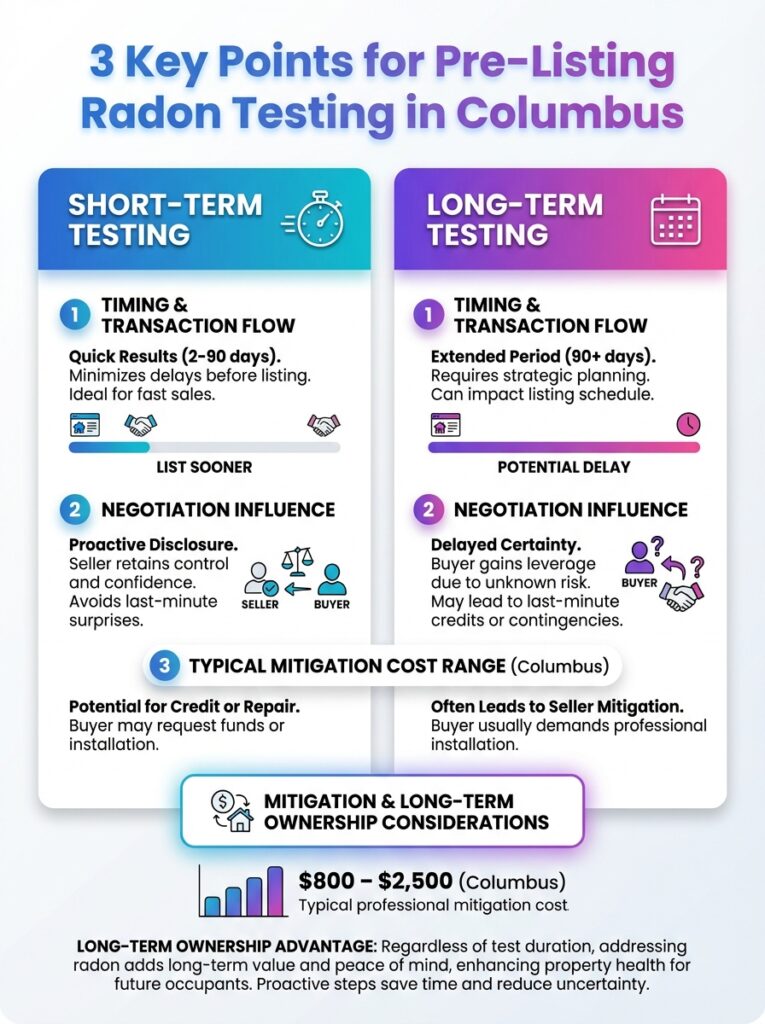
This infographic highlights the three essential steps for a pre-listing radon test in Columbus. Use these guidelines to help ensure accurate results before listing.
Did You Know?
From 2016 through Oct 3, 2025, Ohio distributed 71,434 free radon test kits, only about 1.4% of the state’s roughly 4.9 million households, which means most homes have never been tested.
Best Time Of Year To Do A Pre-Listing Radon Test In Columbus
Radon levels in Columbus homes can change with weather, ventilation habits, and heating patterns, so timing your pre-listing test matters.
We help homeowners choose a test window that gives realistic numbers without slowing down their plans to go on the market.
Winter testing advantages
During Columbus winters, homes are closed up and heating systems often create a stack effect that can draw more soil gas inside.
Because of that, January and February are widely recommended months for testing if you want to capture a higher-end snapshot of what your home might experience.
Spring and summer testing before a move
If you plan to list in spring or summer, it still makes sense to test as soon as you know you will sell, even if conditions are not at peak winter levels.
You may decide to repeat testing in a different season later, but an early result gives you time to plan mitigation or pricing before photos and showings begin.
Using timing to your negotiation advantage
When you test early in a season with reasonably stable indoor conditions, you can present your results to buyers as part of a clear, documented listing package.
That preparation often shortens conversations with buyers and agents later, because you have already addressed the “have you tested for radon” question with data.
Reading Your Pre-Listing Radon Results And Deciding What To Do Next
Once a pre-listing radon test is complete, the key questions for a seller are how to interpret the number and what to do with it.
We walk Columbus homeowners through their reports so they understand how buyers are likely to react.
Understanding common benchmarks
In practice, many buyers and inspectors in Columbus use 4.0 pCi/L as the point where they begin asking about mitigation, because it is the federal guideline level often referenced in real estate documents.
Results well below that value usually give sellers more peace of mind that radon will not become a major negotiation point, though buyers can still test again.
If your pre-listing test is elevated
When a pre-listing test shows a higher level, you essentially have three choices: install mitigation before listing, plan to credit the buyer, or price the home with radon work already in mind.
Each approach can work, and the best choice depends on your budget, timeline, and how competitive your local submarket is.
Using follow-up tests strategically
For borderline or unexpected results, especially if testing occurred during unusual weather or open-window conditions, we often suggest a confirmatory test.
That second data point can either support moving ahead with mitigation or give you more confidence that the first number was not representative.
How Pre-Listing Radon Testing Shapes Negotiations With Buyers
In Ohio, sellers must disclose known radon test results and any mitigation systems on the Residential Property Disclosure Form, so pre-listing testing gives you information you are expected to share anyway.
The advantage is that you learn those numbers early, which lets you shape your listing strategy instead of reacting at inspection time.
Setting expectations in the listing description
If your pre-listing test comes back at a level buyers typically find acceptable, you can highlight “recent radon test on file” in your listing remarks.
That simple line reassures buyers that you have paid attention to a common Columbus concern.
Planning for mitigation credits or installation
If your numbers are higher, you can decide whether to install mitigation before listing or offer a specific credit amount in your property disclosures.
Because we track local pricing closely, we can help you base those credits on realistic system costs, rather than guesses.
Reducing back-and-forth during inspection
When both you and the buyer know the radon situation upfront, there is less room for surprise requests or rushed decision-making after inspection.
That clarity usually leads to smoother negotiations and helps protect your closing date.
Did You Know?
Ohio has no law requiring owners to test for radon before a sale, but sellers must disclose any known radon presence or systems on the Residential Property Disclosure Form.
Radon Mitigation Costs Columbus Sellers Should Expect If Levels Are High
Pre-listing testing sometimes uncovers higher radon levels, and the next logical question for sellers is what mitigation might cost in Columbus.
We draw on real quotes from local homeowners to help you budget realistically.
Typical Columbus mitigation price ranges
Across Central Ohio, most standard radon mitigation systems fall between $800 and $2,500, with many average basement homes landing around $1,200 to $1,800.
The exact price depends on your foundation type, home size, and how easily we can route the vent piping and fan.
Cost differences by foundation type
Basement and slab homes generally see similar price ranges, often between $1,200 and $2,000, while crawl space systems can be higher at roughly $1,500 to $2,500.
Crawl spaces sometimes require additional sealing or encapsulation work, which adds labor and materials but can also help with moisture control.
Long-term cost considerations for sellers
Beyond installation, there are modest ongoing costs like electricity for the fan and occasional monitoring, along with potential fan replacement over the years.
Across a 10-year period, total ownership costs can fall in the $2,800 to $4,200 range, which is helpful context if a buyer asks about future expenses.
Comparing Radon Companies And Financing Options Before You List
Once you know you may need mitigation, pre-listing is often the best time to compare local quotes and choose a company you trust.
We encourage sellers to look at total value instead of focusing only on the lowest bid.
What is a fair mitigation price in Columbus
Recent quote comparisons in the area show many homeowners paying between $1,200 and $2,500 for complete systems, with variations based on foundation complexity and aesthetics.
If a quote is much lower or higher than that range, it is worth asking detailed questions about materials, fan sizing, and what is included.
Key items to compare between companies
When you review bids, look at whether permits, post-mitigation testing, exterior appearance, and warranty coverage are included.
We also suggest confirming whether the installer has experience with your specific foundation type and neighborhood building styles.
Financing mitigation when cash is tight pre-listing
Some Columbus radon companies offer payment plans that spread system costs over 12 to 18 months, with example payments in the $110 to $210 per month range depending on project size.
For sellers who need mitigation to keep a deal moving but want to preserve cash for moving expenses, these options can be worth discussing.
Common Pre-Listing Radon Testing Mistakes Columbus Sellers Should Avoid
We frequently see well-intentioned sellers accidentally set up tests in ways that buyers or inspectors later question.
A few simple steps can help keep your pre-listing results credible.
Improper test placement and house conditions
Tests placed too close to drafts, exterior walls, or heating vents can produce misleading results that do not represent the main living area where buyers care most.
Similarly, leaving windows open or running whole-house fans during a short-term test can distort readings.
Relying on a single quick DIY test forever
A one-time DIY test, especially if done during unusual weather or with poor placement, does not guarantee that future readings will look the same.
We recommend viewing pre-listing tests as one data point and being open to follow-up testing if buyers request it.
Not documenting your process and results
When you can show where the test was placed, how long it ran, and the report you received, buyers are more likely to accept your pre-listing data as valid.
Keeping that documentation handy for showings and inspections is a small step that can prevent unnecessary re-testing debates.
Pre-Listing Radon Testing Strategy For Different Columbus Neighborhoods
Radon affects homes across Columbus, including higher-income suburbs like Dublin, New Albany, and Westerville, as well as older in-city neighborhoods.
We tailor testing and mitigation conversations to the style and expectations of each area.
High-value suburbs with savvy buyers
In wealthier suburbs, buyers often arrive with detailed inspection expectations and sometimes their own radon experience from previous homes.
In these markets, having a recent, clear pre-listing radon test and a documented mitigation plan if needed can be a strong selling point.
Older homes closer to downtown
In established neighborhoods with older foundations and additions, we pay extra attention to test placement and potential multiple suction points for mitigation.
A careful pre-listing test helps you understand how those older construction details might impact your radon profile.
Newer construction and spec homes
Some newer homes include passive radon systems or stubs that can be upgraded with a fan, which often keeps mitigation costs toward the lower end of local ranges.
We still recommend testing, since even newer builds in Zone 1 areas can show a wide range of radon levels from house to house.
Conclusion
For Columbus homeowners, a pre-listing radon test is a practical way to learn about a common local issue before buyers and inspectors do.
By testing early, understanding your results, and planning mitigation or pricing accordingly, you can protect your timeline, reduce surprises, and present your home with confidence in a market where radon is part of many real estate conversations.