Licking County is not just another high‑radon area in Ohio, it sits at the center of a national story, with Newark’s 43055 zone estimated at the highest predicted average radon concentration in the entire United States at about 246 Bq/m³ (around 6.6 pCi/L).
If you live in Newark, Granville, Hebron, Pataskala, or anywhere in Licking County, understanding why this county keeps appearing in “highest radon in America” headlines is essential for planning smart testing and mitigation decisions in your home.
Key Takeaways
| Question | Short Answer |
|---|---|
| Why is Licking County called one of the highest radon areas in America? | State data shows a countywide median around 6.5 pCi/L and long‑term averages over 14 pCi/L, which is why we created a dedicated overview at Licking County Highest Radon Levels. |
| How common are elevated radon levels in nearby Central Ohio homes? | A Columbus investigation found nearly 80% of 68 homes above the EPA action level, which we break down in our Columbus Dispatch radon investigation summary. |
| Can I get a free radon test kit if I live in Ohio? | Yes, many Licking County residents qualify for state-supported kits, and we explain how to request and use them in our Free Radon Test Kit Ohio guide. |
| How reliable are home radon test kits in Ohio? | Certified devices are expected to read within about ±25% of true values, which we detail in our test kit accuracy article so you can trust your results. |
| What does radon mitigation typically cost near Licking County? | In nearby Columbus, most professional systems run about $800 to $2,500, with examples in our 2025 radon mitigation cost breakdown. |
| Are there hidden or long‑term costs to consider? | Permits, post‑testing, electricity, and fan replacement can bring 10‑year totals into the $2,750 to $6,200 range, which we cover in our hidden costs guide. |
| Should I use a short‑term or long‑term radon test in Licking County? | Both have a role, and high‑risk counties benefit from a clear testing strategy that we outline in our short‑term vs long‑term testing article. |
Understanding Why Licking County Shows Some of America’s Highest Radon Levels
Licking County’s radon story starts with decades of measurements, not just one or two alarming readings.
Across 21,460 tests between 2003 and 2020, the county averaged about 14.7 pCi/L, which is more than three times the common 4 pCi/L reference level for considering mitigation.
Geology plays a major role in this pattern.
The underlying soil and rock around Newark, Granville, and nearby townships allow radon gas to move easily up into basements and slab‑on‑grade homes, which is why even newer houses in Licking County often test high.
Statewide analyses rank Licking County at the top for median radon among all 88 Ohio counties.
That means high readings are not just rare spikes, they are part of the everyday background environment that many local homes sit on.
How Newark, Granville, and Hebron Became Radon Hotspots
When national researchers mapped 4.48 million radon measurements across the country, Newark’s 43055 area rose to the top as the highest predicted average radon concentration in the United States.
They placed Central Ohio, including Newark and parts of Licking County, in a high‑risk “Zone 5” where typical levels exceed key reference thresholds in many neighborhoods.
Local reporting has highlighted striking individual readings that bring those maps to life.
For example, one Hebron‑area home recorded a radon level of 58.2 pCi/L, which is more than 14 times the 4 pCi/L benchmark commonly used to recommend mitigation.
In another case, a Licking County building reportedly measured at 1,400 pCi/L.
That kind of number shows just how intense radon accumulation can become in certain structures if the gas is not actively vented away.
What Licking County Radon Statistics Mean For Everyday Homeowners
Living in one of America’s highest radon counties does not automatically tell you what is happening in your own basement or first floor.
Two houses on the same street in Newark or Granville can test very differently, depending on foundation design, cracks, sump pits, and even how often doors and windows are opened.
We encourage homeowners to think in terms of both countywide risk and individual measurement.
The county data explains why testing is strongly recommended, while your specific result guides any mitigation decisions.
Many Licking County homes will measure above 4 pCi/L, but some will fall below that threshold.
Without a properly placed and timed test, there is simply no reliable way to know where your house stands.
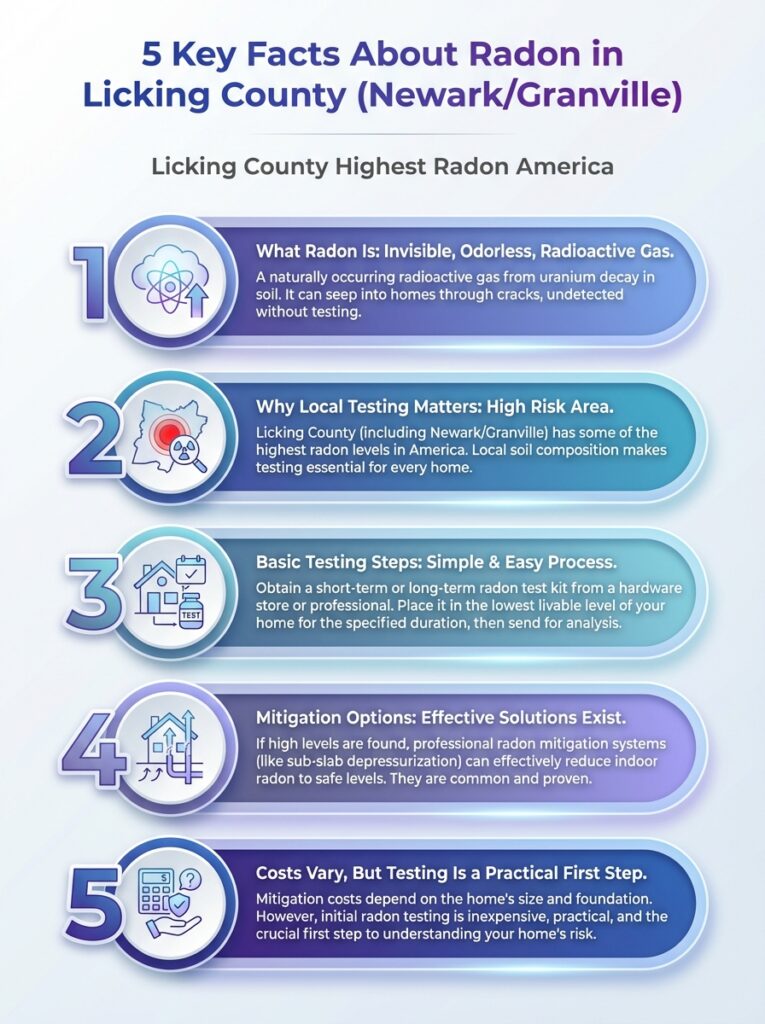
This infographic highlights five key facts about radon in Licking County, including Newark and Granville. Learn what these findings mean for home safety and testing.
Free and Low‑Cost Radon Testing Options for Licking County Residents
Because Licking County sits in a high‑priority zone, state and local programs frequently support free or discounted test kits for homeowners.
Through the Ohio Indoor Radon Program and partner health departments, many residents can request a charcoal test kit at no charge.
Commercially, short‑term radon test kits often cost around $20 to $60, while long‑term devices tend to run $70 to $150.
We help homeowners choose between these options based on timing, budget, and whether they are testing for a real estate transaction or general awareness.
For many Licking County households, our view is simple.
Start with at least one properly placed short‑term test, then follow up with a long‑term test or professional monitor if results are elevated or borderline.
Did You Know?
Licking County has the highest median radon level among all 88 Ohio counties, at about 6.5 pCi/L across thousands of tests.
Short‑Term vs Long‑Term Tests in a County with Extreme Readings
In a county where some buildings have reached readings like 58 pCi/L or even 1,400 pCi/L, it is natural to wonder which test type really gives a clear picture.
Short‑term tests, which usually run 2 to 7 days, are excellent first steps and are widely used during home sales or quick screening.
Long‑term tests, typically 90 days to a full year, smooth out daily and seasonal swings.
They are particularly valuable in high‑risk places like Licking County, where radon can rise in winter and fall in summer or vice versa.
We often recommend a layered approach.
Use a short‑term test to identify whether your radon appears clearly low, clearly high, or borderline, then add a long‑term test or continuous monitor in borderline or higher‑risk homes.
How Accurate Are Radon Tests When Levels Are This High?
With average readings in Licking County already well above common action levels, many homeowners ask how much test accuracy really matters.
The answer is that accuracy is still important, especially for confirming that any installed mitigation system is doing its job.
National proficiency programs expect certified radon devices to read within about ±25% of a known value in controlled conditions.
In practical terms, that means a true value of 10 pCi/L might reasonably show as 7.5 to 12.5 pCi/L on a compliant device.
We guide our customers to use certified labs and devices and to follow placement rules carefully, because user errors can affect results more than device limitations.
If two tests seem very far apart, repeating the test or using a different device type can help clarify the picture before making long‑term decisions.

Typical Radon Mitigation Costs Near Licking County
When Licking County homeowners discover readings in the double digits, the next question often becomes, “What will it cost to fix this?”
In nearby Columbus and Central Ohio, a standard professional mitigation system usually costs between $800 and $2,500, with many installations landing around $1,200 to $1,500.
Smaller, simpler homes on a single basement slab often fall at the lower end of that range.
Larger houses with crawlspaces, multiple foundation sections, or complex vent routing tend to land higher, sometimes above $2,500.
Here is a simple comparison that reflects common scenarios we see in Central Ohio, which are similar for many Licking County homes:
| Home / Foundation Type | Typical System Description | Common Cost Range |
|---|---|---|
| Single‑zone basement | One suction point, exterior fan, basic sealing | $1,200 – $1,500 |
| Basement + crawlspace | Multiple suction points, crawl encapsulation, more pipe | $1,800 – $2,500 |
| Large or complex layout | Custom routing, attic discharge, enhanced sealing | $2,500+ |
We also see more homeowners using financing or payment plans so they can address radon promptly without delaying for budget reasons.
When we design a system for a Licking County home, our priority is a durable installation and measurable reduction rather than simply chasing the lowest possible upfront quote.

Hidden and Long‑Term Costs Licking County Homeowners Should Plan For
Upfront installation is only part of the total cost of owning a radon mitigation system, especially over a decade or more.
When we help Licking County families plan, we walk through permits, post‑installation tests, electricity use, and eventual fan replacement so there are fewer financial surprises.
Over a 10‑year period, many Central Ohio homeowners will invest somewhere between $2,750 and $6,200 when you combine installation, monitoring, and operating costs.
That range varies widely with local permit fees, energy prices, and how many times the fan or system components need service.
Here are some of the common “hidden” items we see people overlook:
- Permit and inspection fees where required by local jurisdictions.
- Follow‑up radon tests after installation to confirm performance.
- Electricity to run the fan continuously, year‑round.
- Fan replacement, often somewhere in the 7 to 10 year window, depending on model and use.
We believe in setting realistic expectations at the start, especially in a county where many homes will rely on these systems for years to come.
Did You Know?
Nationwide, about 26.8% of people may live in homes above key radon reference levels, but Licking County’s averages are significantly higher than that national backdrop.
Comparing Licking County to Columbus and the Rest of Ohio
Franklin County, home to Columbus, is designated as a highest‑risk Radon Zone 1 area, and investigations there have found that nearly 80% of sampled homes tested above common radon action levels.
Licking County sits immediately to the east, sharing much of the same geology but often recording even higher median and average readings in state data.
Compared to many other Ohio counties, Licking stands out in three ways.
It shows a higher countywide median, more frequent double‑digit readings, and several exceptionally high outlier measurements that have drawn national attention.
That does not mean radon is only a Licking or Franklin County problem, since many other parts of Ohio also show elevated levels.
It does mean that Newark, Granville, Hebron, and surrounding communities deserve particular focus in statewide testing and mitigation efforts.
Practical Steps We Recommend for Licking County Homeowners
From our perspective as radon professionals, living in a high‑ranking radon county calls for a simple, practical action plan rather than panic.
We focus on three main phases: measure, decide, and maintain.
In the measurement phase, we encourage every homeowner to run at least one short‑term test in the lowest lived‑in level, following placement instructions carefully.
For homes in Newark, Granville, or Hebron that already know they sit in higher‑risk subdivisions or soils, adding a long‑term follow‑up provides even more clarity.
In the decision phase, we help families weigh mitigation when readings come back elevated.
That includes talking through budget ranges, funding options, and how system design might differ for basements, slabs, or crawlspaces.
Finally, in the maintenance phase, we remind customers to re‑test every few years and after major renovations.
Even in “highest radon” areas, a well‑designed system plus periodic checks can help keep indoor levels under consistent watch.
Conclusion
Licking County’s reputation as one of the highest radon areas in America is grounded in long‑term data, from countywide averages over 14 pCi/L to headline‑grabbing readings in places like Newark and Hebron.
For us, those numbers are a clear call to action for consistent testing, thoughtful mitigation, and honest conversations about both upfront and long‑term costs.
If you own or are buying a home in Licking County, the most important step is simple.
Run a properly placed test, understand your result in context, and, if needed, work with qualified professionals to design a mitigation plan that fits your foundation, your budget, and your long‑term goals for a healthier indoor environment.