Radon is a serious concern across our state, and recent data suggests that an estimated 2.5 million Ohio homes may have a radon problem, while only about 67,668 had mitigation systems installed as of 2021.
We want Ohio homeowners and property managers to know that you can often start with a free radon test kit, so you can understand your risk before you spend money on anything else.
Key Takeaways
| Question | Short Answer |
|---|---|
| How do I get a free radon test kit in Ohio? | You can request a free charcoal test kit through the Ohio Indoor Radon Program, often accessed via local health departments or through testing-focused providers such as Ohio Radon Services. |
| Can I really test my home for free? | Yes, many Ohio residents qualify for free kits provided through federally funded grants, as mentioned by professional testers like Radon Pros. |
| What if my free test shows high radon? | You can contact professional mitigation companies that serve central Ohio, including Columbus Radon Mitigation, for system quotes and long‑term solutions. |
| Are free kits enough for real estate transactions? | For real estate, guidelines typically call for professional testing using continuous radon monitors, such as those used by Radon Pros real estate services. |
| Where can I see Ohio radon risk levels by county? | You can review statewide mapping resources like the Ohio radon map to understand typical levels in your area. |
| Does free testing apply to apartments or multifamily properties? | Free kits are usually aimed at individual households, while large properties often work with services like multifamily radon testing experts. |
1. Why Free Radon Test Kits Matter In Ohio
Radon is a naturally occurring gas that can enter homes through soil, slabs, basements, and crawl spaces, and in Ohio it is common enough that state and local agencies provide free test kits to encourage routine testing.
A standard radon test kit typically costs about $20 at hardware stores, so free kits remove a cost barrier and help more families understand their indoor air conditions.
January is officially recognized as Ohio Radon Awareness Month, and the state typically distributes most free kits during this period.
However, you can usually request a kit at other times of the year through participating programs, especially if supplies are available.
2. How The Ohio Free Radon Test Kit Program Works
Ohio participates in a federally funded indoor radon grant program that supports the Ohio Indoor Radon Program and a network of local health departments.
According to Radon Pros, this program allows homeowners to run a free charcoal radon test by obtaining a kit through these channels.
Local health departments and partner organizations typically distribute short‑term charcoal test kits.
These kits usually include instructions, a small test device, and prepaid return shipping to an accredited laboratory.
- Short‑term charcoal tests usually run for 2 to 7 days.
- They provide a snapshot of your average radon level during that period.
- They are suitable for an initial screening of your Ohio home.


3. Where To Get A Free Radon Test Kit In Ohio
You typically have three main pathways to access a free kit in Ohio: the state indoor radon program, local health departments, and qualified radon testing providers who help connect residents to available grants.
Many Ohio counties promote free kit availability during winter testing campaigns and community health events.
Ohio Indoor Radon Program & Local Health Departments
The Ohio Indoor Radon Program coordinates free kit distribution, often through county or city health departments.
Supplies can be limited, so it is wise to request early, especially around January when demand is highest.
Testing-Focused Providers
Professional radon testing providers like Radon Pros acknowledge these free kit options and often guide homeowners toward them for initial screening.
Ohio-focused companies similar to Ohio Radon Services may include information about free charcoal tests in their testing pages, so residents can combine low‑cost self testing with professional support when needed.
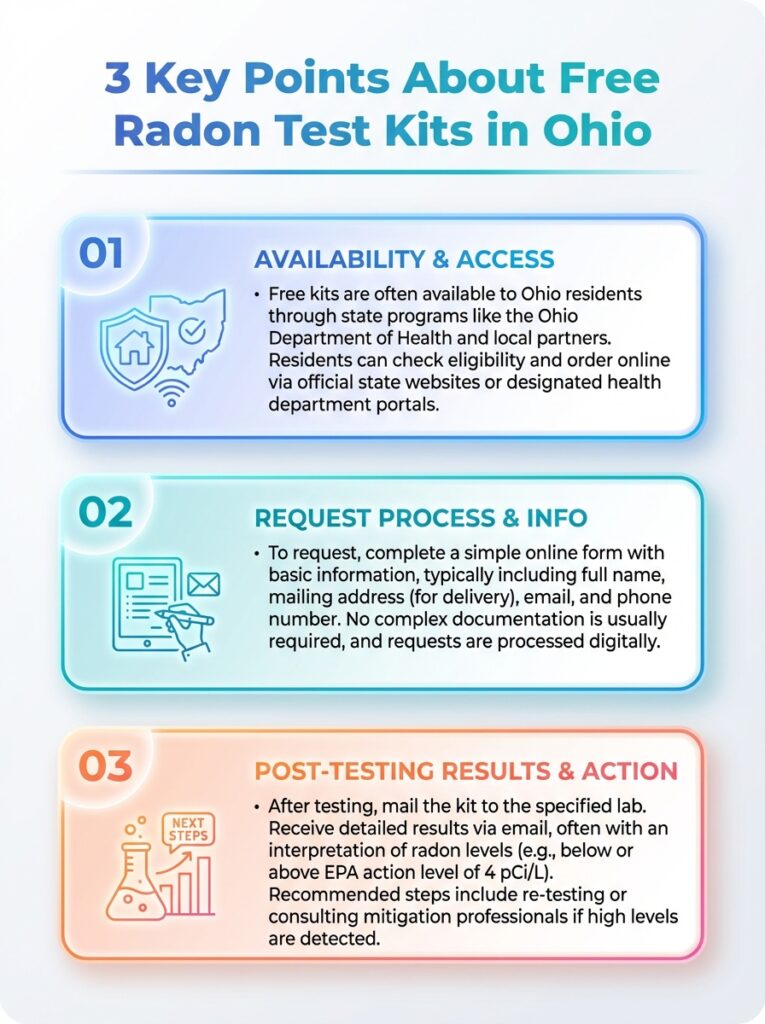
Learn how to obtain a free radon test kit in Ohio. This infographic highlights where to get it, how to use it, and important considerations.

Did You Know?
11,457 free radon tests were distributed by the Ohio Department of Health in 2024, showing how widely available no-cost testing has become for residents.
4. Choosing Between Free Charcoal Kits And Professional Testing
Free charcoal kits are an excellent first step, but they are not your only option.
In Ohio, many homeowners supplement or replace free kits with professional continuous radon monitor testing, especially in time‑sensitive situations.
When Free Kits Make Sense
Free kits are a practical choice if you want to screen your home, you are not in a rush, and you are comfortable following instructions closely.
They are also helpful for repeat checks after mitigation, when you want an additional snapshot over time.
When To Consider Professional Testing
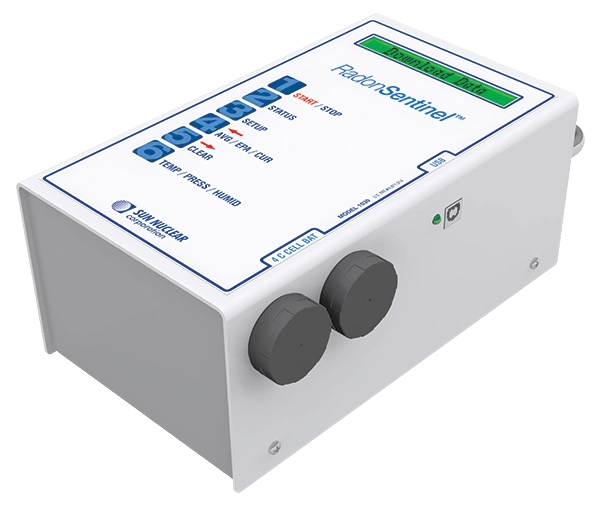
Professional companies, like Radon Pros, use continuous radon monitors from manufacturers such as Sun Nuclear Corporation, which record hourly data and follow national protocols.
These devices are particularly useful for real estate transactions, large buildings, or homes with complex layouts where a single free charcoal test might not provide the most complete picture.
| Option | Best For | Typical Cost In Ohio |
|---|---|---|
| Free Charcoal Test Kit | Initial screening at home | $0 when available through state programs |
| Store‑bought Charcoal Kit | When free kits are unavailable | Around $20 per kit |
| Professional CRM Test | Real estate, complex homes, detailed monitoring | Varies by provider and property |
5. Free Radon Test Kits For Real Estate Transactions In Ohio
In most real estate transactions, buyers, sellers, and agents prefer or require professional testing that follows the EPA testing protocol for real estate.
Radon Pros, for example, uses U.S. EPA verified, NRPP listed continuous radon monitors that are evaluated and approved by the NRSB for use in real estate transaction testing.
While free kits are valuable, they typically are not designed to replace professionally supervised tests when a home is under contract.
Real estate protocols often specify closed‑house conditions and strict timelines that are easier to document with professional devices and reports.
In our experience, free kits are best used before listing your home, so you are not surprised later during buyer inspections.
6. Step‑By‑Step: How To Use A Free Radon Test Kit Correctly
Once your free radon test kit arrives, it is important to follow the instructions carefully so you get reliable results.
Although each brand has its own directions, most charcoal kits in Ohio follow a similar process.
- Choose the right room. Usually the lowest level of the home that you use regularly, such as a finished basement or ground‑floor living room.
- Place the device. Set it on a stable surface, away from exterior walls, drafts, and high heat sources.
- Maintain closed‑house conditions. Keep windows and exterior doors closed as much as possible during the test period.
- Record start and stop times. Accuracy of the exposure time is key for a valid result.
- Mail promptly. Seal the kit and mail it to the lab right after the test ends, using the included envelope.
When the laboratory sends your results, you will see your radon level in picocuries per liter, or pCi/L.
The EPA remediation guideline is 4.0 pCi/L, which is often used to guide decisions about mitigation in Ohio homes.
7. Understanding Your Free Test Results In An Ohio Context
Interpreting a radon report can feel technical, so we explain results in simple terms for our clients.
In Ohio, test results often fall into three broad categories that help guide next steps.
- Below 2.0 pCi/L: Typically considered low; many homeowners simply retest every few years or after major renovations.
- Between 2.0 and 4.0 pCi/L: Some owners choose to monitor, retest, or plan for mitigation in the future, especially if they are already doing other home projects.
- At or above 4.0 pCi/L: The EPA remediation threshold, which usually leads homeowners to obtain professional mitigation quotes in Ohio.
Ohio is among the worst states for radon risk when considering both high prevalence and existing testing levels, according to an American Lung Association study.
This is one reason we encourage every homeowner to start with at least a free kit or low‑cost test at some point.
8. What To Do If Your Free Radon Test Shows High Levels
If your free kit comes back at or above the 4.0 pCi/L guideline, the next step is usually to confirm the result and plan mitigation.
Many Ohio homeowners move from a free charcoal test to a professional continuous monitor test to get more detailed data before making long‑term decisions.
Confirming Results
Because radon levels can vary day to day and season to season, a second test helps confirm that your home consistently measures high.
This might be another free kit if available, a store‑bought kit, or a professional short‑term test managed by a certified company.
Planning Mitigation
Once high levels are confirmed, contractors like Columbus Radon Mitigation install systems to reduce radon levels by redirecting soil gases from beneath the structure to the exterior.
Typical mitigation costs in Ohio range from about $600 to $1,200 per home, with more complex properties sometimes higher.
Did You Know?
In a central Ohio testing wave, 54 of 68 homes (79.4%) measured above 4 pCi/L, far higher than the statewide annual rate of roughly 50% high tests.
9. Free Radon Kits For Apartments, Schools, And Commercial Buildings
Free test kits in Ohio are primarily aimed at individual households, but that does not mean multifamily or commercial properties are left out of the testing conversation.
Larger buildings often need structured testing plans that go beyond one or two individual kits.
For apartments and multifamily properties, services like Radon Pros offer dedicated multifamily testing, which can involve dozens or hundreds of test devices in a single project.
Commercial buildings, including warehouses and offices in the Metro Columbus area, typically work with mitigation companies such as Columbus Radon Mitigation for both testing coordination and system installation.
We encourage property managers to contact professional testers directly, since free single‑family kits usually are not designed to cover entire complexes or schools.
In some cases, local agencies may still provide or subsidize kits for specific units as part of awareness efforts.
10. Common Questions About Free Radon Test Kits In Ohio
We answer many of the same questions from Ohio residents who are using free radon kits for the first time.
Below are concise responses to the topics we hear most often.
How often should I test?
We recommend testing at least every few years, after major renovations, or after installing a mitigation system.
If you used a free kit in winter, it can also be helpful to repeat a test in a different season.
Are free kits as accurate as paid ones?
Charcoal kits from recognized programs use the same basic technology as many store‑bought kits, as long as they are used and mailed according to instructions.
Professional continuous monitors provide more detailed, time‑resolved data but are a different category of testing device.
Can renters in Ohio get free kits?
Many programs are open to any household occupant, but policies vary by county.
Renters can ask their landlords and local health departments about eligibility and best practices for testing their units.
11. How We Support Ohio Homeowners Beyond The Free Test Kit
Free radon kits are a powerful starting point, but our role is to help you interpret the results and decide what comes next for your property.
We work with homeowners, buyers, sellers, and property managers across central Ohio to provide clear guidance at every stage.
Our services include explaining lab reports in plain language, discussing whether a second test is appropriate, and outlining typical mitigation options for different foundation types.
For those ready to take action, we design mitigation systems that reflect Ohio building conditions, from basements and slabs to crawl spaces and commercial facilities.
If you are unsure where to begin, you can always start by requesting a free kit through the Ohio Indoor Radon Program, then contact us once you have your results.
Our goal is to make each step, from your first free test to any needed mitigation, straightforward and understandable.
Conclusion
Free radon test kits in Ohio give households a practical way to learn about their indoor air, without upfront testing costs.
By combining these kits with professional guidance, clear interpretation, and, when appropriate, quality mitigation systems, we help Ohio residents move from uncertainty to informed decisions about their homes and buildings.