Selling or buying a home in Columbus often means dealing with radon, and a central Ohio testing project found that 54 of 68 homes tested were above the typical remediation threshold, so radon is a common issue in local real estate, not a rare surprise.
If you are in a contract or preparing to list, understanding how radon affects inspections, negotiations, and closing timelines can save you stress and money.
Key Takeaways
| Question | Short Answer |
|---|---|
| Is radon testing required to sell a home in Columbus? | No. Ohio does not require pre-sale radon testing or mitigation, but sellers must disclose known radon issues on the state form. Learn how that affects your deal in our guide at negotiate radon mitigation during a Columbus home inspection. |
| Who usually pays for radon mitigation in a Columbus home sale? | It is negotiable. Many buyers ask sellers to install a system or offer a credit. See real negotiation scenarios in 2025 radon mitigation cost data for Columbus homes. |
| How much does radon mitigation typically cost around Columbus? | Most residential systems run about $800 to $2,500, depending on foundation and system design. Detailed breakdowns by home type are available at Columbus radon cost breakdown by foundation type. |
| Can I spread out the cost during a sale? | Yes, many homeowners use payment plans with 0% APR for 6–24 months. You can compare options at Columbus radon mitigation financing options. |
| What if the buyer wants winter testing? | Winter levels in Columbus are often higher, and buyers may prefer testing then. Learn how timing affects your sale at winter radon testing in Columbus. |
| Are there low-cost or free testing options? | Yes. Some libraries and state programs provide low or no-cost test devices. A good starting point is the Columbus Metro Library radon monitor borrowing guide. |
| How accurate are home test kits compared to professional testing? | Placement and timing matter more than price. If you prefer self-testing, review common mistakes at where to place a radon test in your home. |
Understanding Radon In Columbus Home Sales
Radon is a naturally occurring soil gas that can enter homes through cracks, sumps, and utility penetrations.
In the Columbus region, Franklin County’s average indoor radon level is around 6 pCi/L, which is above the common action level used by many professionals, so radon shows up frequently in inspections.
For buyers and sellers, this means radon is more of a standard real-estate topic than an unusual defect. Many purchase contracts in central Ohio now include specific language about radon testing and mitigation timelines.
Why radon matters in Columbus real estate
Columbus and surrounding counties sit in areas that the EPA’s Map of Radon Zones labels as higher potential for elevated levels.
When nearly half or more of homes in an area can show elevated results, buyers learn to ask about radon the same way they ask about roofs or foundations.
How radon fits into your transaction timeline
Most buyers schedule a radon test during the inspection period, often a 7–10 day window after going under contract.
If levels come back above the commonly referenced 4.0 pCi/L threshold, buyers typically request either a mitigation system before closing or a credit so they can handle it after move-in.
Ohio Radon Disclosure Rules Every Columbus Seller Should Know
In Ohio, sellers must use the Residential Property Disclosure Form, and one of the questions specifically addresses radon.
If you know that your home has elevated radon or that a mitigation system was installed, you are required to disclose that on the form.
What Ohio requires for radon during a sale
State law does not require you to test or mitigate before listing your home.
However, it does require you to disclose the presence of radon or a radon mitigation system if you know about it, which is why many sellers choose to test before listing so they are not guessing.
Many buyers and agents in Columbus treat a missing radon answer as a red flag and may push harder for testing during inspection. By testing early, you can complete the disclosure form accurately and avoid last-minute surprises.
Common disclosure scenarios we see
- Seller has never tested, so they disclose “Unknown” and expect the buyer to test.
- Seller tested years ago, records show elevated levels but no mitigation, and buyer requests a new test plus a system if levels are still high.
- Seller already has a mitigation system with recent test results, which often reassures buyers and speeds up negotiations.
How Radon Testing Works During A Columbus Home Inspection
During a Columbus home sale, the radon test is usually ordered by the buyer’s agent and placed shortly after the general inspection.
Continuous monitors or charcoal canisters are set in the lowest livable level of the home, such as a finished basement or first floor.
Short term vs long term tests in a real estate timeline
For real estate, short-term tests are the norm because they provide results within 48 to 96 hours.
Long-term tests (over 90 days) are more common for homeowners who already live in the property and are not constrained by contract deadlines.
Short-term professional tests, often using continuous monitors, typically fall in the same general price environment as mitigation consultations, often referenced in the $800 to $2,500 overall radon service range for Columbus when testing and system planning are combined. Buyers like these devices because they record hourly data, which helps detect tampering or unusual ventilation patterns.
Placing a radon test correctly in your Columbus home
Correct placement is essential for a valid result.
Tests should be 20 inches to 6 feet off the floor, away from drafts, sump pits, exterior doors, or windows, and in a regularly occupied space.
We advise sellers to keep heating and cooling operating normally and to avoid opening windows during the test period. Interfering with the test can delay closing and damage trust between buyer and seller.
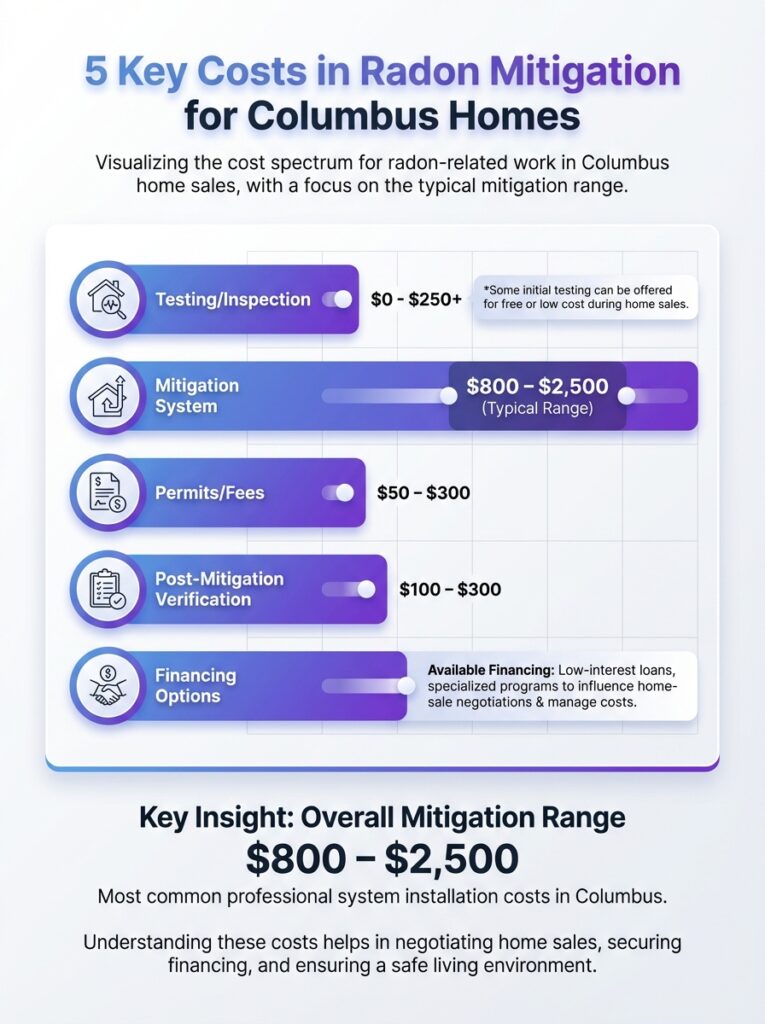
This infographic breaks down the five main costs of radon mitigation in Columbus homes. It helps buyers and sellers estimate budgets during a sale.
Typical Radon Mitigation Costs In A Columbus Home Sale
For most Columbus homes, a standard radon mitigation system falls in the $800 to $2,500 range.
Actual cost depends heavily on foundation type, house size, and whether electrical or aesthetic upgrades are needed.
Average Columbus pricing by home type
Here is what sellers and buyers commonly see in quotes during a transaction:
| Home / Foundation Type | Typical System Description | Usual Price Range |
|---|---|---|
| Basement or slab-on-grade | Single suction point with exterior vent and fan | $1,200 – $1,800 |
| Crawl space | Sub-membrane depressurization with encapsulation | $1,500 – $2,500 |
| Hybrid / multi-foundation | Multiple suction points, combination of slab and crawl solutions | $2,000 – $3,500 |
Across 25 real Columbus homeowners, collected pricing shows whole-house systems typically clustering around $1,200 to $2,500, with some simple installs just under $1,000. When buyers ask us whether $1,800 is too high for a quote, the answer usually depends on the home’s layout, pipe routing, and whether cosmetic upgrades such as interior routing are included.
What you get for the price during a sale
Most real estate focused installations include:
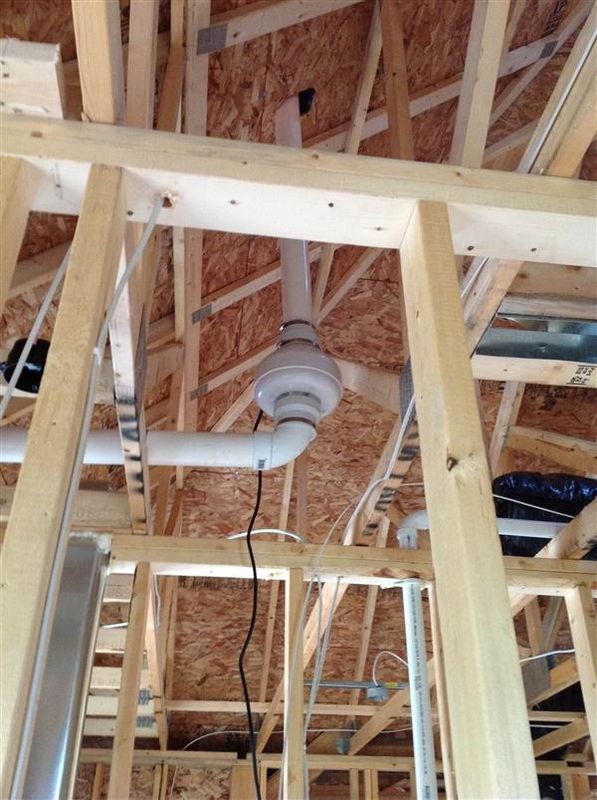
- System design and materials (PVC, fan, caulking, brackets, exterior termination).
- Core drilling through slab or foundation wall and sealing entry points.
- Electrical connection or dedicated outlet for the radon fan.
- Post-mitigation testing to document new levels for the buyer.
Professional systems that are properly installed can reduce indoor radon by up to 99 percent compared to pre-install levels, based on industry data. This performance, combined with documentation, often satisfies buyers and helps both sides close with confidence.

Did You Know?
The typical radon mitigation system costs around $1,200 on average, so many Columbus buyers and sellers simply treat it as another standard closing cost.
Who Pays For Radon During A Columbus Home Sale?
In central Ohio, there is no single rule about who must pay for mitigation.
Instead, radon costs are handled like other inspection items, negotiated between buyer and seller.
Common negotiation approaches we see
- Seller installs system before closing and provides final test results to the buyer.
- Seller offers a credit at closing, often $1,000 to $2,000, so the buyer can choose their contractor.
- Buyer accepts home as-is but often only if levels are near the action threshold and other terms are favorable.
In a buyer’s market, sellers are more likely to agree to full mitigation or larger credits. In a tight seller’s market, some buyers accept smaller concessions or handle mitigation fully after they move in.
How radon affects contract deadlines
Radon tests must be completed within the inspection period, and mitigation, if agreed, must be finished before closing or scheduled via escrow holdbacks.
We recommend building at least 2 to 3 weeks into your timeline if you expect mitigation to be needed, especially during busy seasons.
Radon Risk Around Columbus: What Local Data Tells Buyers
Local data helps both sides understand that radon is a widespread regional issue, not a defect unique to one property.
Franklin County’s average indoor radon around 6 pCi/L and nearby high-risk areas such as parts of Licking County show that elevated levels are common.
What recent Columbus testing efforts show
A central Ohio testing effort that measured 68 homes found that 54 were above 4 pCi/L, which reinforces why buyers routinely ask for testing.
When half or more of tested homes in an area show elevated readings, radon negotiations become a normal part of purchase contracts.
Regional zones and nearby counties
Parts of the Columbus metro fall in higher potential zones on national radon maps.
Nearby Licking County has even been cited in national assessments for higher concentrations, which matters for buyers moving between counties in the region.
Did You Know?
An estimated 50% of Ohio homes may have radon levels above the commonly used 4 pCi/L action level, so Columbus buyers often treat radon testing as a default part of their home search.
Financing Radon Mitigation During A Columbus Transaction
When budgets are tight, financing can make it easier to agree on mitigation without blowing up the deal.
Many homeowners use payment plans that let them cover system costs over time instead of paying the full amount at closing.
How payment plans typically work
Financing programs for radon mitigation in Columbus often feature promotional terms like 0% APR for 6 to 24 months.
After the promotional period, standard APRs can range from about 7% to 18%, depending on credit.
Sellers can use financing to install a system before listing, then recoup some or all of the cost in their sale price. Buyers may also choose to finance post-closing mitigation if they negotiated a partial credit that does not cover the full system cost.
Using credits and financing together
One practical approach is a seller credit of, for example, $1,200 combined with a buyer-financed system of $1,800.
In that case, the buyer only finances the extra $600, which can be spread out affordably while still getting a professional installation.
Foundation Types, System Design, And Home Sale Pricing
Your foundation type is one of the biggest factors in both mitigation design and cost.
During a sale, inspectors, agents, and mitigation contractors all look closely at how the home is built.
Basement and slab homes in Columbus
Basement and slab-on-grade homes typically receive sub-slab depressurization systems.
This means we drill a suction point through the slab, route PVC piping up and out of the home, and attach a radon fan outside or in the attic or garage where appropriate.
These systems usually fall in the $1,200 to $1,800 range in Columbus, depending on pipe routing and electrical needs. Because this is the most common install type, quotes are often very competitive during a sale.
Crawl spaces and hybrid foundations
Crawl spaces frequently require sub-membrane depressurization, where we seal the soil with a heavy plastic membrane and pull radon from beneath it.
This added material and labor usually raises costs to around $1,500 to $2,500 or more, especially when we are tying multiple foundation types together.
Low-Cost And Free Radon Testing Options For Columbus Sellers
Not every owner wants to invest in professional testing before they know whether radon will even come up during their sale.
In Columbus, there are several low-cost or free options that can give you a baseline reading.
Using library monitors before you list
Columbus Metropolitan Library offers free continuous radon monitors at many branches.
You can check out a monitor, place it in your home for several days, then view the average levels to decide whether to pursue professional mitigation or testing.
This is a helpful first step for sellers who want to fill out their disclosure form honestly but are not yet under contract. Buyers sometimes still prefer their own professional test, but early self-testing helps you avoid major surprises.
Placing self-test kits correctly
If you use a mail-in charcoal or digital test, placement is critical.
Follow guidelines such as testing the lowest livable level, avoiding kitchens and bathrooms, and keeping the device away from drafts or windows.
Planning For Post-Mitigation Documentation And Warranties
When radon mitigation is installed as part of a sale, documentation matters almost as much as the system itself.
Buyers want to see that levels dropped and that the system is covered for the future.
What buyers usually ask for after installation
Most buyers appreciate:
- A written system description and diagram showing suction point locations and fan placement.
- Post-mitigation test results from a reliable device or lab.
- Warranty information on the fan and workmanship.
Many professional installers in Columbus offer fan warranties of several years and long-term system warranties on materials and workmanship. This gives buyers confidence that they will not immediately face more radon expenses after closing.
Transferring warranties in real estate deals
We recommend that sellers provide the original mitigation contract and warranty documents at closing.
Most warranties follow the property address, not the individual owner, so the buyer can contact the installer directly if service is needed later.
Conclusion
Radon is a normal part of buying and selling homes in Columbus, especially with so many local properties showing elevated levels in recent testing.
By understanding disclosure rules, testing options, typical mitigation costs, and practical negotiation strategies, you can handle radon confidently and keep your transaction on track.
Whether you are a seller preparing to list or a buyer under contract, planning for potential radon conversations from the start helps avoid last-minute surprises. With clear data, realistic pricing, and professional support, radon becomes a manageable home-sale detail instead of a deal-breaker.