Radon presence must be disclosed in Ohio’s Residential Property Disclosure Form for most home sales, yet many buyers and sellers are still unsure what that actually means for a real estate transaction. In a state where tens of thousands of homes have already been tested, understanding Ohio radon disclosure requirements can prevent last‑minute surprises, failed deals, and expensive misunderstandings at the closing table.
Key Takeaways
| Question | Short Answer |
|---|---|
| 1. What is required in Ohio for radon disclosure when selling a home? | Sellers of 1–4 unit residential properties must disclose any known radon presence or prior radon tests on the Residential Property Disclosure Form. We explain how this plays out during negotiations at this in‑depth real estate guide. |
| 2. Do Ohio laws require a radon test before a home sale? | No statewide law forces testing, but buyers commonly test during inspection. You can see how free homeowner test programs work in our Ohio free radon test kit guide. |
| 3. Which homes are covered by the Ohio radon disclosure rule? | The rule applies to most 1–4 unit residential properties, including typical single‑family homes and small multifamily properties in Central Ohio. Our team works with all of these property types every day from our base at Columbus Radon Pros. |
| 4. How do radon zones in Columbus impact disclosure discussions? | Columbus and much of Central Ohio sit in EPA Radon Zone 1, which means high potential for elevated levels. We break down local risk in our Columbus radon zone overview, which often shapes buyer expectations. |
| 5. What happens if a test during inspection finds high radon? | In practice, buyers and sellers negotiate mitigation or price adjustments. For real Columbus examples and cost ranges, see our 2025 radon mitigation cost breakdown. |
| 6. Are there long‑term costs sellers and buyers should anticipate? | Yes, fans, permits, sealing, and post‑testing add to lifetime system cost. We walk through realistic 10‑year numbers in our hidden radon mitigation cost guide. |
1. How Ohio Radon Disclosure Requirements Work In Residential Real Estate
Ohio law makes radon part of the standard Residential Property Disclosure Form for most home sales involving one to four residential units. In practice, that means sellers need to share what they know about radon in the home, especially any prior testing or mitigation systems.
The rule does not force anyone to test before listing, but it does require honesty about any known radon conditions. As radon awareness grows in Central Ohio, we see more buyers asking specifically about this section of the form during showings and inspection periods.
From our perspective as a Central Ohio radon contractor, the disclosure rule does two important things. First, it signals to buyers that radon is a routine part of due diligence, and second, it helps agents standardize how they ask and answer radon questions for every listing.
Because this is a legal disclosure document, we always recommend that buyers, sellers, and agents consult their own real estate attorney or broker for specific legal guidance. Our role is to explain practical testing, mitigation options, and what typical Columbus transactions look like when radon comes up.
2. What Properties Are Covered Under Ohio’s Radon Disclosure Rule?
Ohio’s disclosure requirement targets the most common housing types: one to four unit residential properties. That includes single‑family homes, duplexes, triplexes, and four‑plexes that are sold in a typical real estate transaction.
Large apartment buildings, commercial structures, and some specialized property types follow different rules and forms. For the average Columbus home buyer or seller though, the standard Residential Property Disclosure Form is the document that brings radon into the conversation.
In our service area we work on all of these property types, so we see how disclosure plays out across different building styles. Split‑levels, slab‑on‑grade homes, basements, and crawl spaces can all show elevated radon levels, which is why the disclosure requirement does not limit itself to basements or older homes.
For investors with small portfolios of duplexes or three‑families, it is especially important to track radon testing results by address. Once you know a property’s levels, you will need to answer disclosure questions accurately on every future sale of that asset.
3. What Sellers Must Disclose About Radon In Ohio
Ohio’s rule is straightforward: if you know about radon issues or prior radon tests, you must disclose that knowledge. That includes existing mitigation systems, documentation of past test results, and any written reports from inspectors or contractors.
What the rule does not do is require sellers to guess or investigate if they genuinely have no information about radon in the home. In that case, the seller answers the disclosure questions accordingly, and the buyer typically chooses whether to test during the inspection period.
From a practical standpoint, we advise sellers to gather any radon‑related documents as soon as they start thinking about listing. That might include test reports from a past purchase, invoices from a mitigation company, or post‑mitigation testing results.
Buyers appreciate clear information, and organized records can make the disclosure section easy to complete. It also builds trust in the transaction, which is valuable when you get into inspection negotiations.
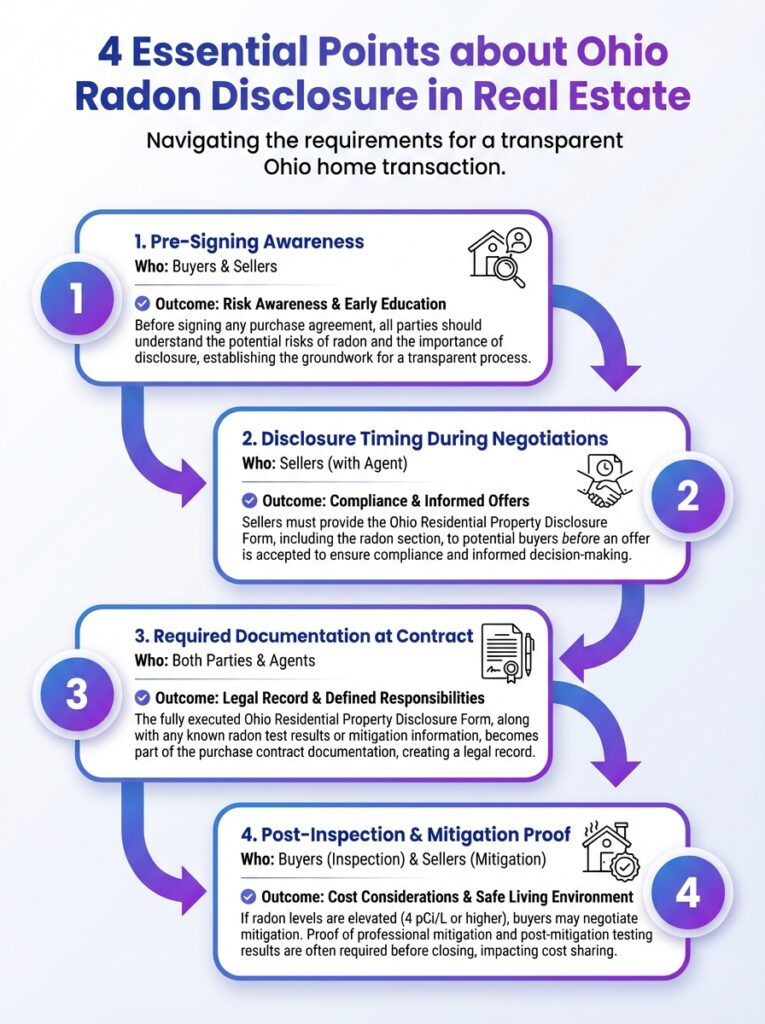
This infographic highlights four essential points about Ohio radon disclosure in real estate. Use it to navigate requirements when buying or selling a home.
Did You Know?
The radon disclosure requirement in Ohio became effective on June 1, 2022, which means many homes bought before that date may not have formal radon disclosure history on file.
4. Buyer Rights: Testing, Inspection Periods, And Negotiating Radon In Ohio
Even though Ohio does not force a radon test before every sale, buyers almost always have a contractual right to test during the inspection period. In Central Ohio, we routinely see radon tests ordered alongside home inspections as a standard package.
If a test reveals elevated levels, buyers and sellers negotiate how to handle mitigation. That conversation often involves comparing mitigation options, looking at quotes, and deciding whether the seller will install a system before closing or credit the buyer at closing instead.

We see a wide range of negotiated solutions in Columbus, but several patterns repeat:
- Seller pays for a complete mitigation system before closing.
- Seller provides a closing credit equal to one or more quotes.
- Buyer accepts the house as‑is and plans mitigation after closing.
Because radon mitigation costs in Columbus typically range from $800 to $2,500 for most homes, it is a manageable negotiation point compared to structural issues. Clear disclosure and recent test results make that negotiation much smoother for everyone involved.
5. How Radon Levels And EPA Guidelines Interact With Ohio Disclosures
While Ohio disclosure law focuses on what is known about a specific property, buyers and sellers still need a way to interpret test results. National guidance from the Environmental Protection Agency sets an action level of 4.0 pCi/L, and most Central Ohio negotiations use that as the key benchmark.
In many Columbus homes we test, initial readings exceed that threshold, especially in basements and lower levels. That reality is part of why the state and local partners offer free radon test kits and special awareness campaigns to encourage more testing.
In disclosure terms, the key question is whether the seller knows that levels at or above this threshold have been measured in the home. If yes, that knowledge belongs in the disclosure, along with information about any mitigation installed afterward.
When our team installs a mitigation system, we always recommend post‑mitigation testing and documentation. That way, future buyers can see initial and reduced levels, which makes both disclosure and negotiation simpler when the home eventually sells.
6. The Role Of Free And Low‑Cost Radon Testing In Ohio Transactions
Ohio’s statewide programs have distributed tens of thousands of free test kits, including many in Central Ohio counties. For homeowners who are not yet ready to list their home, these kits can be an easy way to learn about radon before disclosure is on the line.
For real estate transactions, though, most lenders, agents, and buyers prefer professional testing that follows formal protocols. That provides clear, time‑stamped documentation for everyone reviewing the file.
Our team uses calibrated continuous monitors and follows industry standards so that results will stand up to scrutiny during a home sale. That matters when multiple offers are involved and buyers are comparing risk and cost across several properties.
If you have already completed a state‑provided free test, keep the documentation. Even if you later order a professional test for a sale, that earlier result still counts as “known information” for disclosure purposes.
Did You Know?
Radon disclosure is part of Ohio’s Residential Property Disclosure Form, listed alongside other hazards such as lead paint and asbestos, which underscores how seriously the state treats radon information in home sales.
7. Typical Radon Mitigation Costs Behind Ohio Disclosure Conversations
Once a test result comes in, the next question is almost always cost. In Columbus, we commonly see full mitigation systems priced between $1,200 and $1,500 for a straightforward basement installation and up to $2,200 or more for complex crawl space or hybrid setups.
For example, one Clintonville home with three extraction points came in around $3,200, because the house layout required a more advanced design. These numbers often define the size of closing credits or seller‑paid repairs buyers request after inspection.
To make expectations concrete, here is a simple comparison table of typical mitigation scenarios we see that often become part of disclosure and negotiation:
| Scenario | Typical Columbus Cost Range |
|---|---|
| Single suction point basement system | $1,200 – $1,500 |
| Crawl space system with encapsulation | $1,500 – $2,200 |
| Hybrid or multi‑point system | $2,000 – $3,500 |
When these costs are clear up front, disclosure about known high radon levels no longer has to derail a contract. Instead, everyone can quickly move to concrete solutions that fit the property and the purchase agreement.
8. Financing, Long‑Term Costs, And How They Relate To Disclosure
In addition to installation price, buyers and sellers sometimes worry about long‑term costs related to disclosure decisions. That includes electricity for the fan, eventual fan replacement, permits in some jurisdictions, and follow‑up testing to confirm performance.
Over a 10‑year period, total cost for a typical Central Ohio mitigation system often falls in the $2,800 to $4,200 range when you add those factors together. That long‑term perspective can reassure buyers that they are not taking on an open‑ended financial burden.
Financing options can also make mitigation easier to incorporate into a purchase. Some homeowners use 0% promotional financing, credit unions, or other payment plans to spread the cost out over time instead of absorbing it all before closing.
From a disclosure standpoint, once a system is installed, you will disclose that existence, not just the original high reading. For future sales, that can actually become a selling point instead of a liability, since buyers see that the issue was addressed professionally.
9. How Agents And Contractors Work Together On Ohio Radon Disclosures
Real estate agents in Ohio are on the front line of explaining disclosure forms to clients, and they often bring us in to handle the technical side of testing and mitigation. That partnership helps keep roles clear, with agents handling contracts and negotiation, and our team handling radon data and system design.
We respect that disclosure itself is a legal and brokerage matter. Our job is to provide accurate test results, clear explanations of what those numbers mean, and fair written estimates that buyers and sellers can use during negotiation.

During multi‑offer situations, having professional radon documentation ready can give both listing and buyer agents more confidence as they advise clients. For listings, pre‑listing tests sometimes help set expectations and reduce back‑and‑forth after inspection.
We also frequently consult with agents about how different foundation types, additions, or renovations might affect mitigation design. That way, they can speak accurately when buyers ask what “fixing radon” is likely to involve at a given address.
10. Common Misconceptions About Ohio Radon Disclosure Requirements
We hear several recurring misconceptions about Ohio radon rules that are worth clearing up. One is the belief that the law requires every home to be tested before it can be sold, which is not the case at this time.
Another misconception is that landlords must provide radon information to tenants in the same way they do for sales. Currently, there is no statewide requirement for landlords to disclose prior radon test results to tenants, although local programs and best practices may still encourage it.


Some sellers also assume that disclosing high radon automatically destroys the marketability of their property. In our experience across Central Ohio, that is not what happens when mitigation costs and options are clearly presented up front.
Because radon is so common in our region, most buyers now see it as a solvable building systems issue rather than a unique red flag. Accurate disclosure, professional testing, and realistic mitigation plans are what make that mindset possible.
Conclusion
Ohio radon disclosure requirements are designed to put honest, property‑specific information in front of buyers, not to punish sellers or complicate deals. When you understand that the law focuses on known conditions and applies primarily to 1–4 unit residential properties, it becomes much easier to navigate.
In a high‑risk region like Central Ohio, radon is now a normal part of the real estate conversation. If you are buying or selling and need help interpreting test results, planning mitigation, or budgeting for long‑term system costs, our team is ready to walk you through your options step by step so your transaction can move forward with clarity and confidence.