When the Columbus Dispatch’s 2025 “Invisible Killer” investigation revealed that nearly 80% of 68 tested central Ohio homes were above the EPA’s radon action level, it confirmed what many experts already suspected about our local housing stock and soil conditions.
Key Takeaways
| Question | Answer |
|---|---|
| What did the Columbus Dispatch Investigation 2025 actually find? | The Dispatch tested 68 central Ohio homes and reported that nearly 80% were above the EPA’s 4.0 pCi/L action level, with some readings above 20 pCi/L, which we summarize in detail in our Columbus Dispatch radon investigation breakdown. |
| How does this connect to free testing options in Columbus? | Following the investigation, the Columbus Metropolitan Library launched a free continuous monitor lending program described in our Columbus library radon testing guide. |
| Is Columbus officially a high‑risk radon area? | Yes, Franklin County is classified as EPA Radon Zone 1, which we explain in our Columbus radon risk zones article. |
| Are wealthy neighborhoods safer from radon? | No, the investigation and follow‑up testing show elevated radon in luxury areas like Dublin and New Albany, which we discuss in our wealthy Columbus radon testing report. |
| How much does radon mitigation typically cost in Columbus? | In 2025, typical systems range from $800 to $1,500 for simpler homes and up to $2,000 to $4,000 for complex layouts, based on our 2025 mitigation cost guide. |
| Do costs change based on foundation type? | Yes, basement systems often run $1,200 to $1,500, while crawl spaces and hybrids can reach $1,500 to $3,500, as outlined in our foundation‑type cost comparison. |
| Where can I learn about local deals and awareness events? | Our Columbus Radon Awareness Week 2026 overview tracks community resources, free kit programs, and seasonal testing pushes that grew out of the 2025 coverage. |
What The Columbus Dispatch Investigation 2025 Revealed About Radon In Central Ohio
The Columbus Dispatch’s “Invisible Killer” series focused on a simple but urgent question: what are actual radon levels inside ordinary central Ohio homes. Their team placed monitors in 68 residences of different ages, sizes, and price points across the metro.
The results were blunt. Nearly 80% of those homes measured above the EPA action level of 4.0 pCi/L, and several properties registered above 20 pCi/L, a range that demands prompt attention and follow‑up mitigation by industry best practice standards.
Our team followed this reporting closely because it validated what we see in Columbus basements every week. Radon is not limited to one ZIP code or one house style, and it can show up in both older bungalows and newer construction.
The series also highlighted a systemic gap in public awareness. Many of the featured homeowners had never tested before, which is one of the reasons we now point so many callers directly to Dispatch coverage for context before we talk through testing options.
How The Dispatch Coverage Sparked The Columbus Library Radon Testing Program
One of the most immediate community responses to the 2025 Dispatch investigation was the launch of the Columbus Metropolitan Library continuous monitor lending program. The library partnered with the paper to lower the entry barrier for first‑time testers.
Instead of mailing a charcoal kit and waiting weeks for a lab, Columbus residents can borrow a plug‑in continuous radon monitor for $0, place it in a frequently used lower‑level room, and watch readings change in real time over several days.
Every one of the 23 branches is expected to host at least one unit, and residents can reserve them just like a book. For families who learned about radon for the first time through Dispatch headlines, this offers a practical next step that does not require a contractor visit on day one.
From our perspective as installers, we see the library program as an excellent screening tool. When a family sees consistently elevated readings at home on a borrowed monitor, they usually feel much more confident calling us to discuss long‑term mitigation options.
Columbus As An EPA Radon Zone 1 Area: Why The Investigation Numbers Were So High
Some homeowners were surprised that nearly 80% of tested houses in the Dispatch investigation exceeded 4.0 pCi/L, but the numbers track closely with federal mapping. Franklin County is firmly classified as an EPA Radon Zone 1 county, which is the highest risk tier.
Zone 1 counties are predicted to average indoor radon levels above 4.0 pCi/L, largely due to geology and soil composition. In our region, uranium‑bearing glacial tills and tight clay soils help trap radon beneath slabs and in crawl spaces until it finds cracks and openings into homes.
We often explain the EPA’s three‑zone system to callers who are reading about the Dispatch series for the first time. Zone 1 suggests a strong recommendation to test, Zone 2 suggests testing is still advisable, and Zone 3 means the probability of elevated levels is comparatively lower but not zero.
Even within Franklin County, the Dispatch investigation showed variability from home to home, but not the “safe bubble” that some people assumed existed in specific neighborhoods. This is why we recommend testing for any occupied Columbus home, regardless of age or price point.
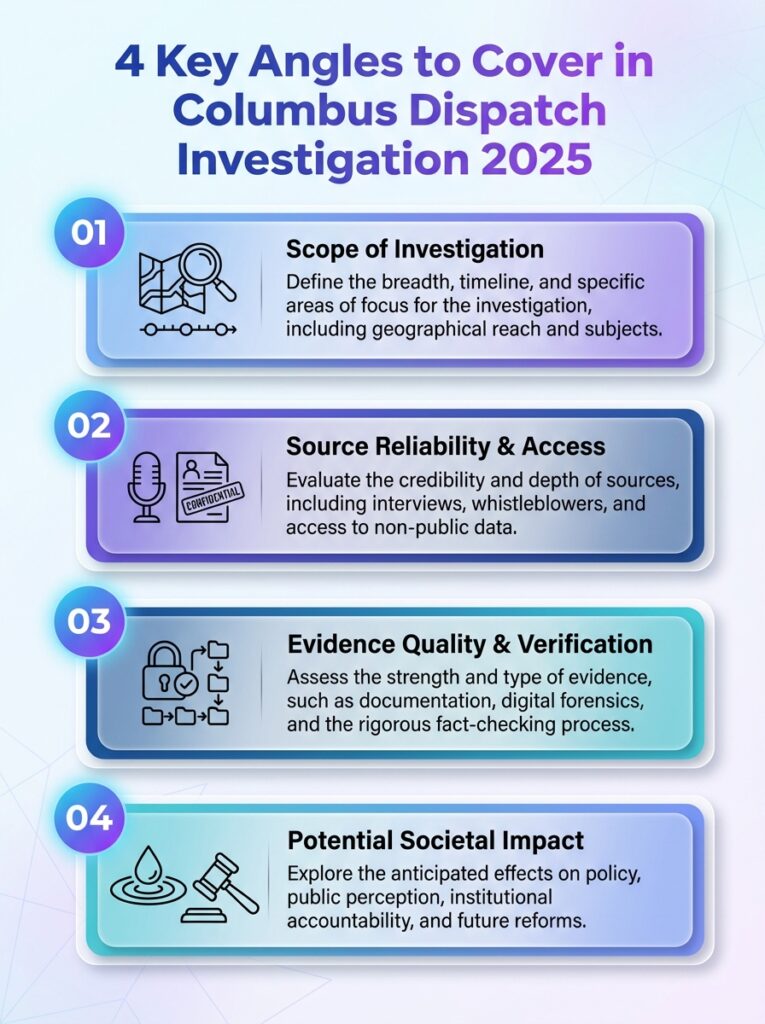
A visual guide highlighting four essential angles for the Columbus Dispatch Investigation 2025. Use this infographic to follow the coverage and track how it connects to your own home’s radon risk.
Did You Know?
About 1,000 Ohioans are missing on any given day, a scale of concern highlighted in the Dispatch’s broader VANISHED investigation that ran alongside its 2025 accountability reporting.
High Radon Readings In Wealthy Columbus Neighborhoods: What The Investigation Confirmed
One myth the Dispatch series helped puncture is that radon is mainly a problem in older or lower‑priced homes. The data, and our field experience, show significant radon levels in high‑end houses from Dublin and New Albany to Westerville.
Large square footage, extensive finished basements, and multiple foundation types can actually make radon management more complex in luxury properties. The soil under a million‑dollar home can emit just as much radon as the soil under a starter condo a few streets away.

In our own testing in affluent neighborhoods, we regularly see readings well above the EPA guidance threshold in newer builds that otherwise feature premium windows, insulation, and mechanical systems. High‑efficiency envelopes can actually hold radon in more effectively if it is not intentionally vented.
The lesson from the Dispatch investigation is that no buyer should skip radon testing just because a property is in a desirable subdivision. We encourage real estate agents and buyers in every price band to include radon results in their due diligence.
What The Investigation Means For Everyday Columbus Homeowners
For many readers, the most practical question after reading the Dispatch coverage is simple: “What should we do next at our own address.” From our vantage point, the investigation makes a strong case for three basic steps.
First, plan at least one reliable radon test for any Columbus‑area home, regardless of age or neighborhood. Second, if you see readings at or above the EPA’s action level, speak with a qualified mitigator about design options for your specific foundation type rather than relying on generic advice.
Third, budget realistically by using local cost data instead of national averages. The Dispatch reporting and our own surveys of 25 Columbus homeowners show that many straightforward basement systems fall in the $800 to $1,500 range, with more complex projects running higher.
Most families who contact us mention that they first heard in detail about radon through local media. We see our role as turning that awareness into clear options, not pressure, so homeowners can decide what level of risk reduction fits their comfort level and budget.
2025 Columbus Radon Mitigation Costs: Insights Born From Post‑Investigation Demand
After the Dispatch series, mitigation inquiries rose sharply across central Ohio. That increased demand helped clarify what homeowners here actually pay for installed systems in real‑world conditions, not just on paper.
From our 2025 data, we saw typical Columbus mitigation projects cluster in three bands: simpler basement‑only systems at $800 to $1,500, crawl space or complex footprint systems at $1,500 to $2,500, and multi‑suction or multi‑foundation projects that may reach $2,000 to $4,000.
To make sense of quotes, we encourage homeowners to ask each contractor to break pricing into labor, materials, sealing work, and post‑mitigation testing. This mirrors how we present our own bids and gives a clearer comparison than a single lump‑sum figure.
The Dispatch investigation did not publish price charts itself, but by putting radon on the public agenda it pushed many of us in the local industry to share more transparent cost breakdowns so that families are not guessing in the dark about project budgets.
Basement vs Crawl Space vs Slab: Why Foundation Type Became A Focus After 2025
One nuance that often gets lost in high‑level coverage is how strongly foundation design affects mitigation design and cost. After 2025, we spent more time than ever helping homeowners connect their Dispatch‑inspired concerns to the specifics of their house.
In broad terms, our 2025 Columbus projects showed that basement or slab‑on‑grade systems tended to fall in the $1,200 to $1,500 range, crawl spaces in the $1,500 to $2,500 range, and mixed‑foundation homes between $2,000 and $3,500, depending on access and layout.
Crawl spaces often require sub‑membrane depressurization, which means laying and sealing a durable vapor barrier before running piping to a fan. While that adds cost, it can also help manage moisture and odors, which many homeowners consider an added benefit.
The Dispatch investigation pushed more residents to ask detailed questions about what is under their feet, which in turn helps us design systems that fit both their risk tolerance and their house structure instead of applying a one‑size‑fits‑all approach.
Did You Know?
In 2024, 21,342 Ohioans were reported missing, including 16,404 children, with 96.5% recovered, a broader context that shows why investigators and journalists in 2025 were already deeply engaged in public‑safety reporting.
Community Awareness Efforts After The Dispatch Series: Radon Week And Beyond
The Dispatch investigation dovetailed with a growing local push to treat radon as a routine home maintenance issue instead of a niche concern. Columbus Radon Awareness Week 2026 built directly on that momentum.
During the awareness campaign, city and county partners promoted free or low‑cost test kits, shared maps of Zone 1 areas, and encouraged residents to talk openly about radon levels with neighbors, landlords, and real estate professionals.
As a local radon company, we participate by offering educational content, answering questions about test reports, and providing no‑obligation quotes for those who decide mitigation is right for them. Our goal is to match the level of detail people see in investigative journalism with equally clear technical guidance.
We have found that when residents understand both the Dispatch statistics and their own home’s test results, they feel empowered to make measured decisions instead of reacting out of fear or ignoring the issue entirely.
Breaking Down Costs In Plain Language: Lessons From Homeowners Post‑Investigation
One recurring theme in calls we received after the Dispatch series was confusion about price. Homeowners saw generic figures online, then received local quotes that did not always match those numbers.
To address this, we built a detailed cost breakdown that mirrors how we structure actual Columbus bids: basement single‑point systems usually at $1,200 to $1,500, crawl space and more complex systems at $1,500 to $2,500, and hybrid or multi‑point setups up to $2,000 to $3,500.
We also explain that price reflects more than a fan and some PVC. Professional systems involve diagnostic work, core drilling or slab penetration, sealing of joints and cracks, roof or wall penetrations, and a final verification test to document the new radon level.
By putting all of this in writing, we aim to bring the same transparency to mitigation that the Dispatch brought to testing data. When homeowners see the full picture, they can judge value instead of focusing solely on the lowest upfront bid.
How The 2025 Investigation Changed Our Day‑To‑Day Work In Columbus
From our perspective, the Dispatch Investigation 2025 did more than produce headlines. It permanently raised baseline awareness in Columbus about what radon is and how common elevated levels are in ordinary homes.
Today, many of the families who contact us have already read data from the 68‑home test set, understand that Franklin County is Zone 1, and know that both older and newer properties can show elevated readings. That lets us skip basic myth‑busting and move straight to tailored advice.
We see our role as complementing that journalism with clear, local, and practical guidance. Where the Dispatch reported that nearly 4 out of 5 sampled homes were above the EPA action level, we help each individual homeowner figure out where their specific property falls on that spectrum and what options fit their situation.
As awareness continues to grow, we expect more Columbus buyers to treat radon results as a standard part of purchase negotiations, more sellers to install systems proactively, and more landlords to test rental properties as a matter of routine care.
Conclusion
The Columbus Dispatch Investigation 2025 put hard numbers behind something many experts already knew about central Ohio: elevated radon is common, not rare, in our local housing stock. By testing 68 homes and finding nearly 80% above the EPA action level, the series made that reality impossible to ignore.
In response, community partners expanded free testing programs, local companies like ours shared clearer cost and design information, and homeowners began asking more specific questions about their own basements and crawl spaces. If you live anywhere in the Columbus area and have not tested yet, the safest next step is simple, low‑cost measurement followed by a calm conversation about mitigation options if your readings are elevated.