Columbus, Ohio has average indoor radon levels reported above 8.0 pCi/L -- more than double the EPA action level -- making radon negotiation a common part of local real estate deals. If you are struggling with how to handle radon in your home purchase or sale, there is a proven approach that can save you thousands while protecting your family's health.
Why Radon Negotiation Is So Common in Columbus
Central Ohio geology allows radon to move through soil and into basements and slab homes, which is why so many tests register at or above the EPA action level of 4 pCi/L. Radon is the second leading cause of lung cancer in the United States, responsible for approximately 21,000 deaths annually according to the EPA.
Columbus and Franklin County sit in EPA Radon Zone 1, the highest potential category for elevated indoor radon. Because of this, radon conversations are now common in offers, inspection reports, and addendums instead of being a niche concern.
Action Levels and Their Role in Negotiation
The EPA recommends fixing homes at or above 4 pCi/L, and that number often becomes the reference point in negotiations. If a test shows levels below that threshold, buyers and sellers usually treat radon as lower priority. Higher results nearly always trigger a request for mitigation or credits. Even levels between 2.0 and 4.0 pCi/L pose health risks over long-term exposure.
Ohio Radon Laws, Disclosures, and Your Negotiation Leverage
Ohio requires sellers to disclose the presence of radon in residential property on the state Residential Property Disclosure Form. This disclosure framework sets the stage for negotiations about who will pay for testing, mitigation, or credits.
On the disclosure form, sellers must report known radon tests and mitigation systems, including approximate dates and any available documentation. If a seller knows of high radon levels or existing mitigation equipment, buyers should see that information before inspections end. Learn more about Ohio radon disclosure requirements.
How Disclosures Affect Buyer Strategy
When a disclosure mentions radon, buyers gain leverage to request updated testing, system inspections, or cost sharing based on current readings. Even if a system is present, buyers often ask for proof that it is functioning and delivering results below 4 pCi/L.
However, sellers are only required to disclose what they know. If they have never tested, they can legitimately check "unknown" on the form, which means the burden often falls on buyers to conduct professional radon testing during their inspection period.
Radon Testing During a Columbus Home Inspection
Professional radon testing during real estate transactions typically costs about $150 to $300, a small fraction of the overall transaction. That modest cost can give you solid data to negotiate fair terms without stalling the sale.
When to Order a Radon Test
Buyers usually schedule tests right after the purchase contract is signed, often as part of the overall inspection period. That timing leaves enough room to receive lab results, compare quotes, and negotiate repairs or credits before contingency deadlines.
Short-Term vs. Long-Term Testing
Most real estate transactions in Columbus rely on short-term tests (48 to 96 hours) because they fit typical closing timelines. Continuous radon monitors are preferred because they provide hour-by-hour readings and tamper detection. Long-term tests can provide more seasonal insight but rarely match contract deadlines.
The process requires "closed-house conditions" 12 hours before and throughout testing: windows and doors remain closed except for normal entry and exit, HVAC systems operate normally, and no fans run in windows or attic ventilators.
Radon Mitigation Costs in Columbus: What the Numbers Look Like
In Columbus, professional radon mitigation typically costs between $800 and $2,500 for a standard residential system. These figures often frame the credits or repairs written into contracts.
Cost Breakdown by Foundation Type
- Basement: $900 -- $1,500 (most common)
- Crawl space: $1,200 -- $2,000 (more labor-intensive)
- Slab-on-grade: $1,500 -- $2,500 (requires sub-slab depressurization)
- Hybrid / multi-foundation: $2,000 -- $3,500 (multiple suction points needed)
Hidden Costs to Consider
- Electrical work: Dedicated circuits if not already available ($150 -- $300)
- System maintenance: Fan replacement every 10 to 15 years ($300 -- $500)
- Post-mitigation testing: Verifying system effectiveness ($150 -- $200)
- Warranty considerations: Premium systems with transferable warranties cost more upfront but add long-term value
Three Negotiation Strategies That Actually Work
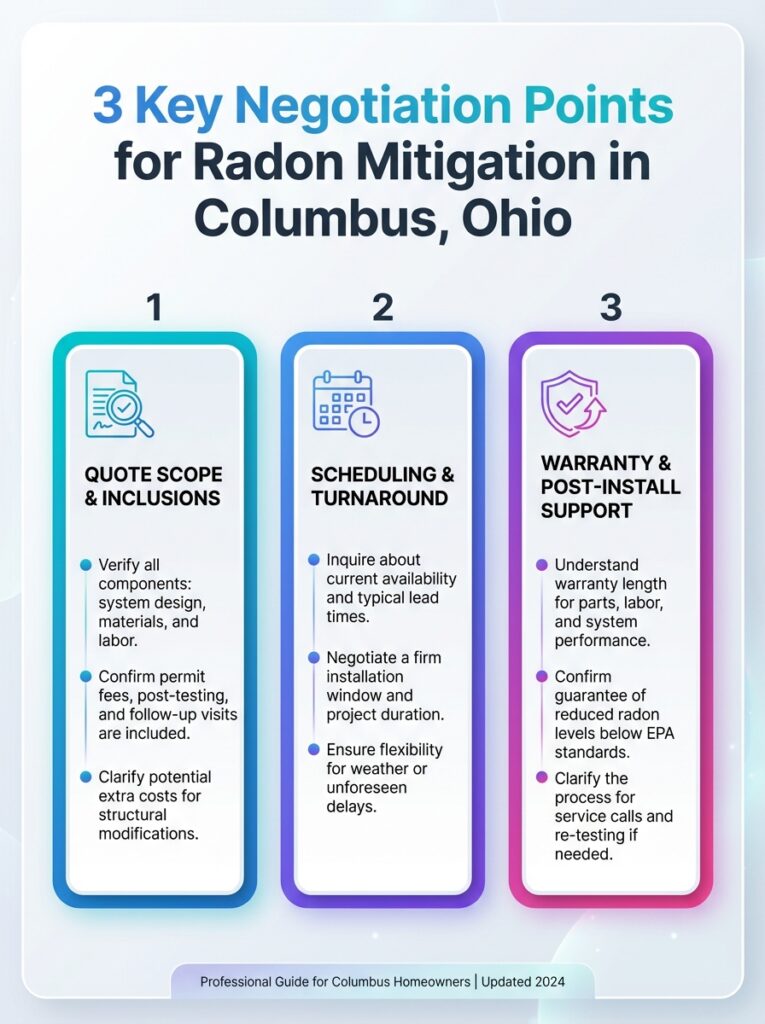
After being involved in dozens of radon negotiations in Columbus, there are three primary approaches -- each with distinct advantages depending on your situation.
Strategy 1: Request Seller-Paid Mitigation
You ask the seller to install a radon mitigation system before closing.
Advantages: System installed and functioning before you move in. Seller handles contractor selection and payment. Post-mitigation test confirms effectiveness.
Disadvantages: Sellers often choose the cheapest contractor. You have no control over system quality or aesthetics. Rush installations may compromise workmanship.
Best for: Buyers who want immediate peace of mind and do not want to deal with contractors post-closing.
Strategy 2: Request a Credit at Closing
Seller provides a credit (typically $1,000 -- $1,500) at closing, and you arrange mitigation after purchase.
Advantages: You choose your preferred contractor and system quality. You control timing and can coordinate with other home projects. You receive warranty benefits directly in your name.
Disadvantages: You breathe elevated radon levels until installation. You must handle contractor coordination. If installation costs exceed the credit, you cover the difference.
Best for: Buyers who value contractor choice and quality control over immediate installation.
Strategy 3: Hybrid Approach
Seller pays for the system, but the buyer approves the contractor and specifications.
Advantages: Best of both worlds -- quality control and seller payment. System installed before closing. Warranty transfers to you.
Best for: Experienced buyers in competitive markets who can negotiate these terms.
Step-by-Step: How to Negotiate When Radon Is Elevated
Your home inspection reveals radon levels at 6.8 pCi/L -- significantly above the EPA action level. Here is what to do:
Step 1: Understand Your Leverage
Your leverage depends on market conditions (buyer's vs. seller's market), the test results themselves (4.1 pCi/L vs. 15.0 pCi/L create different urgency), property desirability, and your contingency clause timeline.
Step 2: Get Multiple Quotes
If you are requesting a credit, get 2 to 3 quotes from licensed Columbus radon mitigation companies. This documentation strengthens your position with actual market pricing rather than guesses.
Step 3: Frame Your Request Strategically
Use language like: "The professional radon test revealed levels at [X] pCi/L, above the EPA action level. We would like to move forward with this purchase, and we are requesting either installation of a professional radon mitigation system before closing, or a credit of $[amount] at closing to address this health concern."
This collaborative framing -- reaffirming your commitment to purchase while presenting options -- tends to yield better results than ultimatums.
Step 4: Consider Splitting the Cost
In challenging negotiations, offering to split mitigation costs can break impasses. For example: seller pays for system installation ($1,200), buyer covers post-mitigation testing and any additional work needed.
Seller Strategies: Protecting Your Price
Sellers in Columbus can treat radon negotiation as another line item to manage, not a reason for a deal to fall apart.
Pre-Listing Testing and Disclosure
Some sellers choose to test before listing so they understand their position in advance. If levels are low, highlight that result. If levels are high, plan mitigation or credits instead of scrambling later. Consider pre-listing radon testing to get ahead of buyer concerns.
Offering Mitigation or Credits Upfront
When a seller already knows radon levels are above the action line, listing remarks can mention a planned credit or willingness to install a system. This reduces surprise and shows buyers you are proactive and reasonable.
Documenting Completed Work
If you already installed a system, keep invoices, warranties, and post-mitigation test results in one place. Organized documentation leads to smoother negotiations and builds trust.
Buyer Strategies: Getting Radon Addressed Without Losing the House
Writing Strong, Fair Radon Clauses
Include a clause that requires testing and outlines specific next steps if the result is above a defined threshold. Clear language about who orders testing, who chooses the contractor, and what happens if levels are elevated avoids confusion later. For details on contract language, see our guide to radon contingencies in Ohio.
Prioritizing Solutions Over Confrontation
Most buyers find more success asking for standard mitigation or a fair credit based on a quote rather than demanding extreme concessions. A calm, solution-oriented tone leads sellers to cooperate more readily on radon topics.
Sample Timeline for a Smooth Radon Negotiation
- Day 1 -- 3: Buyer orders radon test immediately after contract acceptance.
- Day 4 -- 7: Results come back. Buyer requests quotes from mitigation providers.
- Day 8 -- 10: Parties negotiate whether seller installs before closing or provides a credit.
- Before closing: If installing pre-closing, contractor completes work and performs a follow-up test.
Common Negotiation Outcomes in Columbus
| Scenario | Common Outcome |
|---|---|
| Buyer test shows > 4 pCi/L | Seller pays for mitigation or provides credit around expected system cost |
| Existing system, mixed documentation | Buyer asks for re-test and minor repairs, shared or seller-paid |
| Very high level results | Larger credits or more robust system quotes requested, sometimes with re-test after installation |
Does Radon Affect Home Value?
A properly installed radon mitigation system typically increases home value because it demonstrates the problem has been professionally addressed. Future buyers have one less concern during their inspection, and it signals proactive home maintenance.
Conversely, known elevated radon levels without mitigation can significantly impact value and marketability. Ohio's disclosure requirements mean future owners will know about the issue.
Red Flags and Common Mistakes in Radon Negotiations
- Skipping professional testing: Never rely on old tests or neighboring homes' results. Radon levels vary dramatically between adjacent properties.
- Using DIY kits for real estate: Transactions should use certified professionals with tamper-evident equipment.
- Accepting "I have lived here 20 years and I am fine": Radon health effects are cumulative and take years to manifest.
- Not getting post-mitigation testing: Require professional testing before closing to verify the system works.
- Letting $1,200 kill a deal: Do not let mitigation cost derail your dream home. Compare it against your overall purchase price.