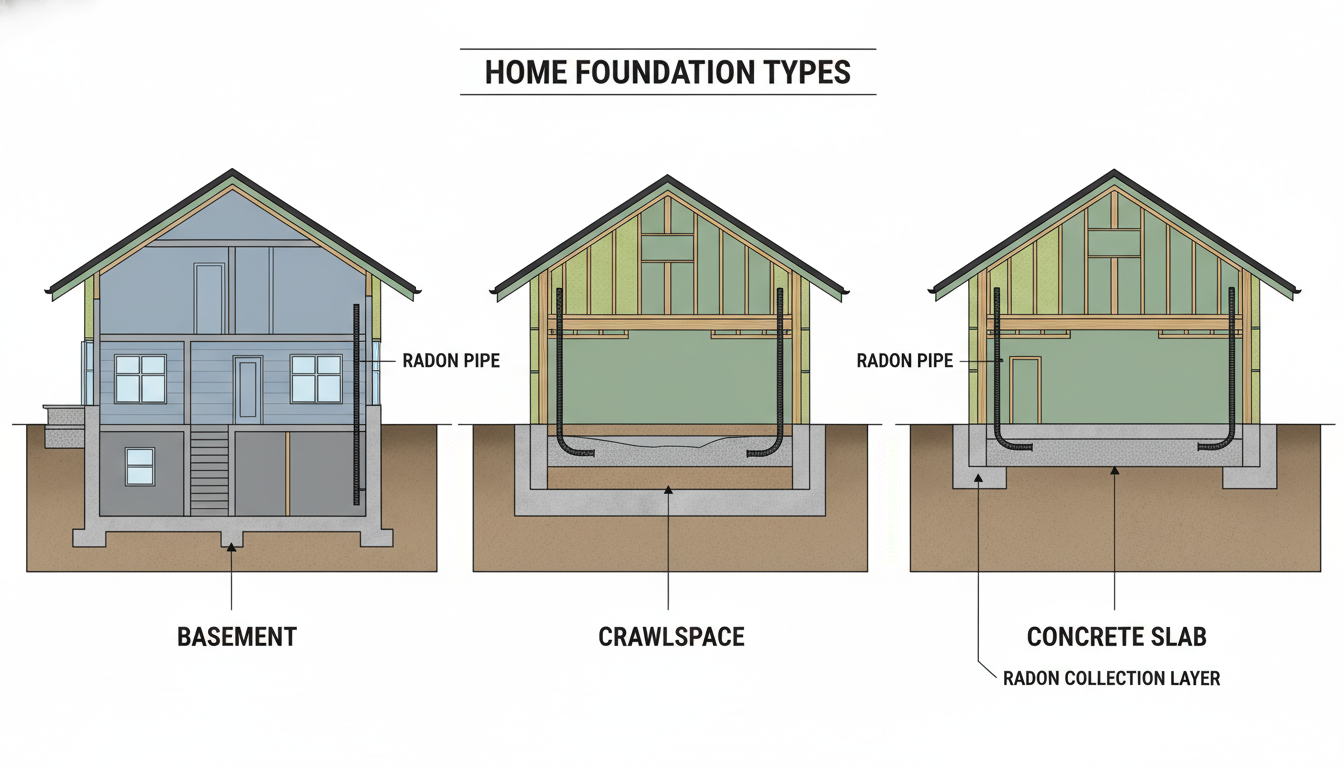
When I first heard that my crawl space was the reason behind my home's elevated radon levels, I assumed fixing it would cost thousands more than a standard basement system. After helping dozens of Columbus-area homeowners navigate this situation, I've learned that crawl space radon mitigation costs typically range from $1,500 to $2,500 in Central Ohio -- and that investment delivers 90-99% radon reduction while simultaneously solving moisture problems.
Foundation Type Cost Comparison
| Aspect | Basement | Crawl Space | Slab-on-Grade |
|---|---|---|---|
| Cost Range | $800-$1,800 | $1,500-$2,500 | $1,000-$2,000 |
| Barrier Type | Existing concrete slab | Vapor membrane installed | Existing concrete slab |
| Install Time | 3-6 hours | 6-12 hours | 4-8 hours |
| Effectiveness | 90-99% | 90-99% | 90-99% |
| Added Benefits | Radon reduction only | Radon + moisture + energy | Radon reduction only |
Basement Radon Mitigation: Most Affordable Option
Cost: $800-$1,800
Basement homes are the easiest and least expensive to mitigate. The existing concrete slab provides a natural barrier, and contractors simply core a 3-4 inch hole through the slab to install a sub-slab depressurization system. Most Central Ohio homes built before 2000 have full basements, making this the most common scenario.
What Affects Basement Mitigation Cost
- Finished vs. unfinished: Finished basements add $300-$600 for careful drilling and surface protection
- Sump pump integration: +$200-$400 for specialized sealing
- Multiple suction points: +$300-$600 per additional point for homes over 2,500 sq ft
- Interior vs. exterior routing: Exterior adds $200-$400
A Clintonville homeowner's 1920s home with a basement, crawl space, and dirt-floor storage area required three extraction points and specialized sealing -- total cost: $3,200. Worth every penny for peace of mind.
Crawl Space Radon Mitigation: Why It Costs More
Cost: $1,500-$2,500
Crawl space systems require fundamentally different techniques. Instead of drilling through an existing slab, contractors install heavy-duty polyethylene membrane across the entire crawl space floor, seal it to foundation walls and around penetrations, then install suction pipes beneath the membrane.
Crawl Space Cost Breakdown by Size
- Small crawl space (under 800 sq ft): $1,500-$1,800
- Medium crawl space (800-1,200 sq ft): $1,800-$2,200
- Large crawl space (1,200+ sq ft): $2,200-$2,500+
Access dramatically affects labor costs. A 1,000 sq ft crawl space with 48 inches of clearance might cost $1,800, while the same space with only 24 inches costs $2,300 because installers work on their stomachs.
Vapor Barrier Quality Matters
- Economy (6-10 mil): $0.15-$0.30/sq ft -- adequate for dry crawl spaces
- Standard (12-15 mil reinforced): $0.40-$0.60/sq ft -- better puncture resistance
- Premium (20 mil antimicrobial): $0.70-$1.20/sq ft -- best for Columbus's high-moisture clay soil
Most professional crawl space encapsulation in Columbus uses 12-20 mil barriers as standard. The 6-mil barriers from hardware stores tear easily and degrade within 2-3 years.
Additional Crawl Space Cost Factors
- Existing barrier in poor condition: +$200-$400 for removal
- Standing water or drainage issues: +$300-$800 for drainage correction
- Debris removal: +$150-$400
- Mold remediation: +$500-$2,000 (separate from radon work)
Crawl Space Encapsulation: The Complete Solution
Combining radon mitigation with full crawl space encapsulation provides exceptional value. A homeowner in Upper Arlington combined both for $3,200 total. Her energy bills dropped $30-$40 monthly, meaning the encapsulation portion paid for itself in 3-4 years.
Benefits beyond radon reduction:
- Moisture control: Eliminates 90%+ of crawl space humidity
- Energy efficiency: Reduces heating/cooling costs 10-20%
- Mold prevention: Dry environments prevent mold growth
- Pest deterrence: Sealed barriers discourage insects and rodents
- Structural protection: Prevents wood rot and foundation damage
Slab-on-Grade Radon Mitigation
Cost: $1,000-$2,000
Slab homes require careful diagnostic testing to determine if sub-slab depressurization will be effective. More common in newer Columbus suburbs like New Albany, Dublin, and Hilliard. The installation process is similar to basement systems, but limited access for multiple suction points can increase costs.
Why Columbus Crawl Spaces Have Higher Radon
Franklin County sits in EPA Radon Zone 1 with over 60% of homes testing above 4.0 pCi/L. Crawl space homes face even higher risk:
- Direct soil contact: Dirt floors provide zero barrier to radon entry
- Stack effect: Temperature differences pull radon from crawl space into living space
- Glacial till soil: Dense clay throughout Central Ohio traps and concentrates radon
- High water table: Columbus's clay soil retains moisture, forcing radon upward
A study of 400 Columbus-area homes found crawl space homes averaged 8.2 pCi/L versus 5.9 pCi/L for basement homes -- nearly 40% higher radon concentrations.
Geographic Price Variations in Columbus
Crawl space mitigation pricing varies by suburb:
- German Village / Clintonville: $1,500-$2,300 (historic homes, challenging access)
- Dublin / New Albany / Powell: $1,500-$2,100 (newer construction, better conditions)
- Westerville / Gahanna: $1,400-$2,000 (competitive contractor market)
- Grove City / Hilliard: $1,400-$1,900 (straightforward installations)
- Licking County: $1,600-$2,400 (extreme radon levels require robust systems)
Case Studies: Real Columbus Results
German Village Historic Home
- Built: 1915, stone crawl space, 30-inch clearance, 900 sq ft
- Initial radon: 18.3 pCi/L
- System: Complete encapsulation (15 mil), three suction points, exterior fan
- Total cost: $2,400
- Result: 0.7 pCi/L (96% reduction), humidity dropped from 85% to 52%
Westerville Newer Construction
- Built: 2008, poured concrete crawl space, 40-inch clearance, 1,200 sq ft
- Initial radon: 8.9 pCi/L
- System: 20 mil vapor barrier, single suction point, variable-speed fan
- Total cost: $1,850
- Result: 1.2 pCi/L (87% reduction), operating cost just $7/month
Average Results Across Columbus Metro
Data from 200+ crawl space installations shows:
- Pre-mitigation average: 11.2 pCi/L
- Post-mitigation average: 1.1 pCi/L
- Average reduction: 90.2%
- 97.5% achieved below 4.0 pCi/L on first attempt
Ongoing Costs by Foundation Type
Ongoing costs are similar regardless of foundation type:
- Electricity: $5-$18/month (fan runs 24/7)
- Fan replacement (10-15 years): $400-$850
- Biennial testing: $75-$200 per test
- Annual inspection: $99-$150 (recommended for crawl space systems)
For a complete breakdown of long-term expenses, see our guide on hidden radon mitigation costs. Need help affording mitigation? Explore financing options for Columbus homeowners.
DIY vs. Professional: Foundation Matters
DIY basement systems are challenging but possible for skilled homeowners. DIY crawl space systems? Exponentially more difficult due to cramped spaces, heavy vapor barrier material, precise sealing requirements, and building pressure dynamics. A Westerville homeowner attempted DIY crawl space installation for $600 -- post-test showed 7.2 pCi/L (still dangerous). Professional redesign cost an additional $2,200, totaling more than professional installation would have cost initially.
For all foundation types in Columbus's high-radon environment, professional installation is strongly recommended.