
In a recent Central Ohio investigation, 79.4% of tested homes showed radon above the EPA action level, which means the accuracy of your Ohio radon test kit directly affects how confidently you can act on your home's results.
Why Ohio Radon Test Kit Accuracy Matters
Ohio sits in some of the highest radon potential zones in the country, including large portions of Central Ohio classified as EPA Zone 1. Your home is more likely than average to have elevated readings, so the accuracy of your test kit directly affects how you decide to respond.
We see homeowners every week who used a kit once, then shelved the results because they were unsure if the number could be trusted. Our goal is to help you understand what "accurate enough" really means in Ohio and when you should consider professional testing.
How Accurate Is "Accurate Enough" for Radon Tests?
National proficiency programs expect test device readings to land within about plus or minus 25% of a controlled chamber value. That range might sound wide, but in practice it gives clear guidance on whether your home is above or below the EPA action threshold.
What matters most in Ohio homes is not a perfect decimal, but whether repeatable tests consistently place you in a low, borderline, or clearly elevated range.
Short-Term Charcoal Kits vs Continuous Monitors
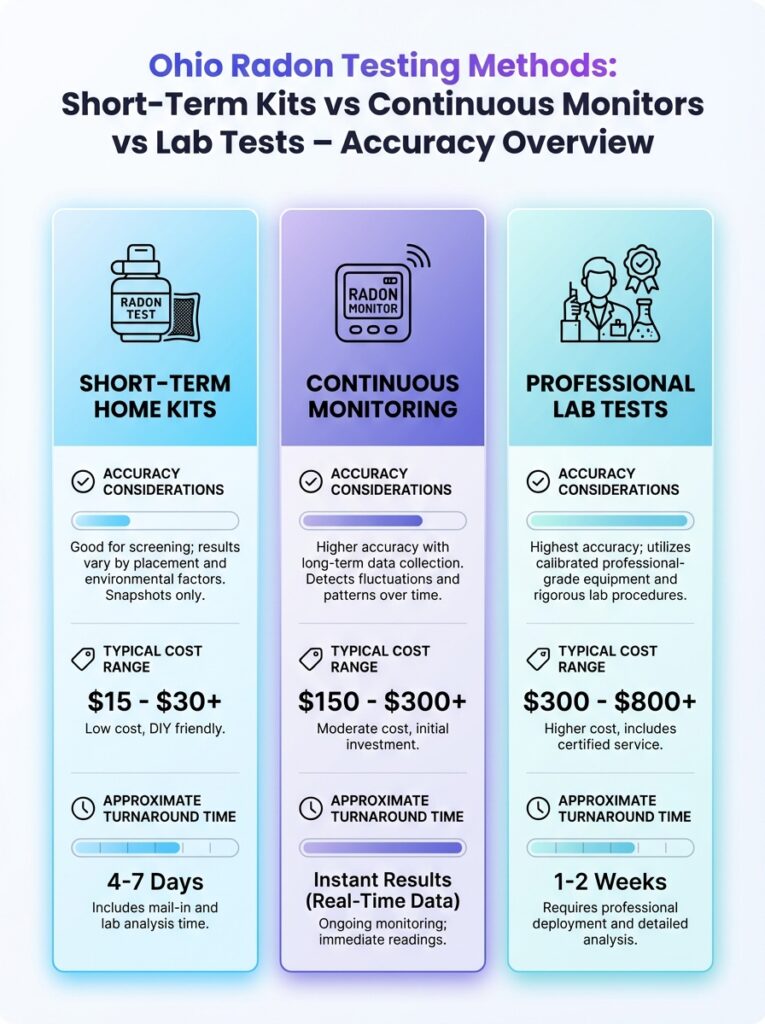
For Ohio homeowners, the main choice is between short-term charcoal kits and electronic continuous radon monitors. Both can be accurate when used correctly, but they behave differently in real homes.
Charcoal kits passively absorb radon over a few days, then you mail them to a lab. They are heavily dependent on following directions about placement, timing, and mailing. Small handling errors can have a larger impact on your final number.
Continuous monitors take readings every hour, giving a clearer picture of daily swings. They shine in longer tests because extended exposure time smooths out short spikes and dips. The Columbus Metropolitan Library's free monitor loan program offers homeowners access to these devices. Learn more about short-term vs long-term testing.
Consumer-grade electronic monitors show two performance groups: conforming devices with average differences under 22%, and non-conforming devices with much larger errors up to 238%.
Common Sources of Error in Ohio DIY Radon Test Kits
Even the best-designed radon test kit can give misleading results if not used correctly. In Ohio, we regularly see three user-driven issues:
- High humidity exposure: Charcoal kits do not perform well near kitchens, bathrooms, or sump pumps
- Poor sealing before mailing: Letting radon escape or air leak in changes the measurement
- Incorrect placement: Kits on windowsills with drafts, in direct sunlight, or beside furnace registers skew results away from the breathing zone
For continuous monitors, errors more often come from bumping, unplugging, or moving the device during the test. Read our detailed guide on where to place a radon test and DIY testing mistakes to avoid.
Ohio Regulations That Support Testing Accuracy
Ohio treats radon testing as a regulated activity for professionals. Licensed radon testers must list their instruments, calibration routines, and quality control procedures with the state. Any significant changes require approval from the director.
For homeowners, those rules mean a licensed tester brings a documented process for keeping equipment within acceptable accuracy ranges. DIY kits you buy online are not subject to Ohio's licensing rules, which is why it is important to choose brands that participate in national proficiency programs.
Interpreting Your Ohio Radon Test Results
Once you have a result, here is a simple framework for Ohio homes:
- Below 2.0 pCi/L: Typically low risk. Retest every few years or after renovations
- Between 2.0 and 4.0 pCi/L: Closer monitoring warranted, especially in high-risk counties. Consider a long-term follow-up test
- At or above 4.0 pCi/L: Mitigation is worth serious consideration, even if daily fluctuations mean the number varies
When two different methods disagree, we look at duration, seasonal timing, and how closely instructions were followed before deciding which result to lean on.
Free and Low-Cost Radon Test Options in Ohio
Many Ohio homeowners first encounter radon testing through free programs, library loans, or low-cost kits from awareness campaigns. Ohio's free test kit efforts have reached tens of thousands of households.
When you receive a free kit from a public program, you are typically getting a device from a vetted lab that participates in proficiency programs. In our experience, those kits are just as capable as retail options, provided you follow the guidelines on placement, exposure time, and mailing deadlines.
Professional Radon Testing in Ohio: When Extra Accuracy Matters
DIY kits are an excellent starting point, but there are situations where professional testing provides needed precision: home sales, complex foundations, and very high preliminary readings.
We use calibrated continuous monitors, controlled protocols, and tamper checks to reduce as many variables as possible. For sellers and buyers, that process creates results both sides can rely on when deciding whether to request mitigation.
From Accurate Test to Effective Mitigation
Once accurate testing shows consistently elevated radon, your focus shifts to reduction. In Central Ohio, typical active soil depressurization systems fall in the $1,200 to $2,500 range, depending on home size, foundation type, and suction points needed.
Post-mitigation testing is a critical accuracy checkpoint. We always recommend a follow-up test after installation to confirm the system keeps levels in the target range. Over time, periodic re-testing, even with DIY kits, verifies continued performance.
Practical Checklist: Getting the Most Accurate Reading
- Choose a kit or monitor from a recognized brand that participates in national proficiency testing
- Test the lowest regularly used level of your home
- Keep windows and exterior doors closed during the test period
- Place the device 2 to 6 feet above the floor, away from drafts, sunlight, and humidity
- Do not move or disturb the device during testing
- For charcoal kits, seal and mail immediately when the test period ends
- Repeat testing in another season if your result is near the decision threshold
If you have questions about how much to trust your number, contact us to discuss your results and plan next steps.