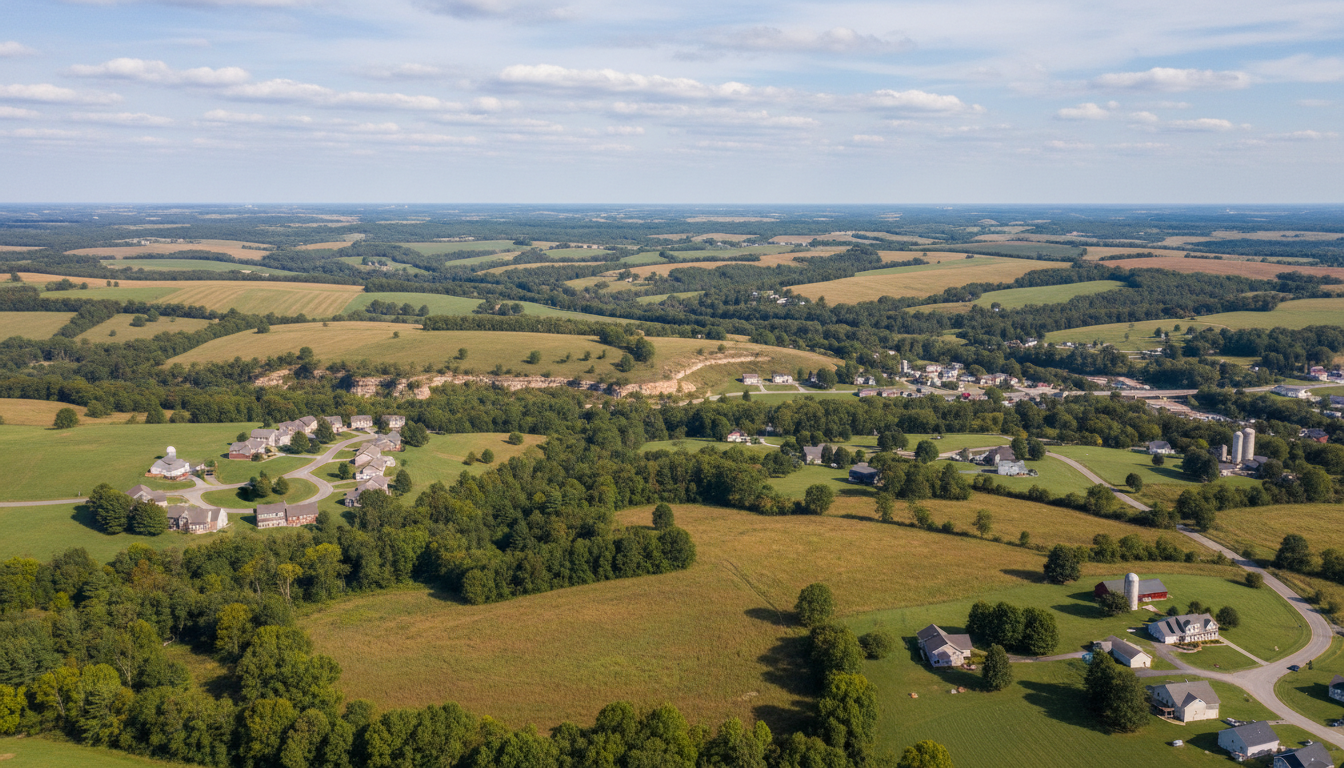
Licking County is not just another high-radon area in Ohio -- it sits at the center of a national story. According to Ohio Department of Health data from 2003 to 2020, Licking County has the highest radon concentration of any county in Ohio, with a median of 6.5 pCi/L across 21,460 tests and an average reaching a staggering 14.7 pCi/L. That is more than 3.5 times the EPA's 4.0 pCi/L action level. Newark's 43055 zip code has been identified as having the highest predicted average radon concentration in the entire United States at approximately 246 Bq/m3 (around 6.6 pCi/L).
If you live in Newark, Granville, Pataskala, Hebron, Heath, Johnstown, or anywhere in Licking County, understanding these numbers is essential for protecting your family from the second leading cause of lung cancer in America.
The Alarming Statistics Behind Licking County's Radon Problem
Here is what makes Licking County unique in the worst possible way: approximately 75% of homes in the county test above the EPA's 4.0 pCi/L action level. To put this in perspective, while neighboring Franklin County (Columbus) already sees about 60% of homes testing above safe levels, Licking County's rate is even higher.
| Metric | Licking County | National Average |
|---|---|---|
| Median radon level | 6.5 pCi/L | ~1.3 pCi/L |
| Average radon level (21,460 tests) | 14.7 pCi/L | ~1.3 pCi/L |
| Homes above EPA action level | ~75% | ~26.8% |
| EPA Zone classification | Zone 1 (Highest Risk) | Varies |
Living in a home with 14.7 pCi/L -- Licking County's average -- is roughly equivalent to smoking eight cigarettes per day in terms of lung cancer risk. The EPA estimates that radon causes over 21,000 lung cancer deaths annually in the United States, making it the leading cause of lung cancer among non-smokers.
Why Licking County Radon Levels Are So Extreme
The geological factors creating Licking County's radon problem are distinct but understandable. Central Ohio sits atop glacial till soil with heavy clay composition -- perfect conditions for trapping uranium-rich materials that decay into radon gas. Unlike areas where radon can dissipate through porous soil, Licking County's dense clay acts like a pressure cooker, forcing radon gas upward through any available pathway into homes.
The county's bedrock contains elevated levels of uranium-bearing shale formations. As uranium naturally decays, it produces radium, which then breaks down into radon gas. This invisible, odorless radioactive gas seeps through foundation cracks, sump pump openings, utility penetrations, and even through concrete itself.
When national researchers mapped 4.48 million radon measurements across the country, Newark's 43055 area rose to the top as the highest predicted average radon concentration in the United States. Individual readings have been striking: one Hebron-area home recorded 58.2 pCi/L (more than 14 times the action level), and one Licking County building reportedly measured at 1,400 pCi/L.
Radon Levels by Licking County Community
While the entire county carries Zone 1 risk, radon levels can vary dramatically even between neighboring homes due to differences in construction quality, foundation type, soil conditions, and ventilation. The major population centers show consistently elevated readings:
- Newark (43055, 43056, 43058): High concentrations across all zip codes, with 43055 identified as the highest-risk zip code nationally
- Granville (43023): Elevated levels consistent with county averages
- Pataskala (43062): Significant radon presence, bordering Franklin County
- Heath (43056): Zone 1 classification with elevated readings
- Hebron: Site of extreme individual readings including the 58.2 pCi/L home
- Johnstown (43031): High-risk area near Knox County border
The only way to know your specific radon level is through professional radon testing. Your neighbor's results do not guarantee your own safety.
Health Risks for Licking County Residents
Radon exposure does not cause immediate symptoms. There is no cough, no headache, no warning sign that you are breathing in radioactive particles. When you inhale radon gas, radioactive particles get trapped in your lung tissue. As these particles continue to decay, they release small bursts of energy that damage cells lining your lungs. Over years of exposure, this cellular damage accumulates and can lead to lung cancer.
The risk factors that amplify radon health risks include:
- Duration of exposure: The longer you live in a high-radon environment, the greater your cumulative risk
- Radon concentration level: Higher pCi/L readings accelerate cellular damage
- Smoking status: Smokers exposed to radon face exponentially higher lung cancer risk (the effects multiply rather than simply add)
- Time spent at home: People who work from home or are retired face greater exposure
In Licking County, where the average reading of 14.7 pCi/L is nearly four times the EPA action level, the lifetime lung cancer risk for non-smokers is approximately 4 in 100 -- comparable to the cancer risk from smoking half a pack of cigarettes daily.
Testing Options for Licking County Homeowners
Despite Licking County's severe radon problem, there is a concerning testing disparity. While the county shows higher testing rates than many Ohio counties (66 per 1,000 housing units according to the American Lung Association), the vast majority of homes remain untested. Ohio has no laws requiring radon testing in homes, apartments, schools, daycares, or workplaces.
Free and Low-Cost Testing
Through the Ohio Indoor Radon Program and partner health departments, many Licking County residents can request a charcoal test kit at no charge. The Ohio Department of Health free test kit program offers kits to homeowners with household incomes under $80,500. Commercial short-term kits cost around $20 to $60, while long-term devices run $70 to $150.
Columbus-area residents can also access the Columbus Metropolitan Library radon monitor lending program for free continuous monitoring.
Professional Radon Testing
Professional radon testing typically costs $99 to $200 and provides superior accuracy. NRPP-certified testers use continuous radon monitors that provide detailed hourly readings over 48 to 96 hours with tamper-proof documentation. Professional testing is essential for real estate transactions, pre-mitigation assessments, and accurate baseline readings. Learn more about test kit accuracy and short-term vs. long-term testing.
Radon Mitigation Systems for Licking County Homes
The gold standard for radon reduction is active soil depressurization (ASD). A certified contractor drills suction points through your basement floor or crawl space, installs PVC piping running vertically through the home, mounts a specialized radon fan in the attic or on an exterior wall, and vents the gas above the roofline. The fan runs continuously to maintain negative pressure beneath the foundation.
Professional radon mitigation systems are remarkably effective. When properly designed and installed by certified contractors, ASD systems reduce radon levels by 90 to 99%. Licking County installations have shown homes with initial readings of 35+ pCi/L reduced to below 1.0 pCi/L.
Mitigation Costs by Foundation Type
| Foundation Type | System Description | Cost Range |
|---|---|---|
| Basement (most common) | Sub-slab depressurization, 1-2 suction points | $800 - $2,500 |
| Crawl space | Vapor barrier, sealed vents, dedicated vent pipe | $1,500 - $3,000 |
| Slab-on-grade | Sub-slab depressurization with diagnostic testing | $1,000 - $2,500 |
| Multiple foundation types | Customized system, multiple suction points, strategic sealing | $2,000 - $4,000 |
Over a 10-year period, many Central Ohio homeowners invest between $2,750 and $6,200 total when combining installation, monitoring, electricity ($60 to $150 per year), and eventual fan replacement ($300 to $500 every 5 to 10 years).
Comparing Licking County to Columbus and Ohio
Franklin County, home to Columbus, is also designated as a highest-risk Radon Zone 1 area. The Columbus Dispatch investigation found that nearly 80% of sampled homes tested above common radon action levels. Licking County sits immediately to the east, sharing much of the same geology but recording even higher median and average readings.
Compared to other Ohio counties, Licking stands out in three ways: a higher countywide median, more frequent double-digit readings, and several exceptionally high outlier measurements that have drawn national attention. Many other parts of Ohio also show elevated levels, but Newark, Granville, Hebron, and surrounding communities deserve particular focus in statewide testing and mitigation efforts.
Real Estate Considerations in Licking County
Ohio requires home sellers to disclose known radon issues from previous testing, but there is a critical loophole: sellers are only required to disclose radon information if they have actually tested. This creates a situation where some sellers deliberately avoid testing to avoid disclosure obligations. In Licking County, where 75% of homes exceed EPA action levels, many buyers unknowingly purchase high-radon homes.
If you are buying a home in Licking County, protect yourself by including radon testing in your home inspection contingency, requesting a professional continuous monitor test, and budgeting $1,000 to $2,500 for potential mitigation costs. Do not waive your inspection contingency. For more details, see our guides on radon contingencies in Ohio and radon negotiation strategies.
Your Action Plan for Licking County
Living in one of America's highest radon counties calls for a simple, practical action plan rather than panic. Focus on three phases: measure, decide, and maintain.
- Week 1 -- Get tested: Schedule a professional 48-96 hour continuous monitor test or request a free test kit. Maintain closed-house conditions during testing.
- Week 2 -- Review results: If below 2.0 pCi/L, retest every 2 years. If 2.0-4.0 pCi/L, strongly consider mitigation. If 4.0+ pCi/L, proceed to mitigation (this affects 75% of Licking County homes).
- Weeks 3-4 -- Install mitigation: Get quotes from 2-3 NRPP-certified radon mitigation contractors. Most systems are installed in a single day (4-8 hours).
- Week 5 -- Verify effectiveness: Conduct post-mitigation testing 48-72 hours after installation. Confirm levels are below 2.0 pCi/L.
- Ongoing -- Maintain your system: Check manometer monthly, listen for fan operation quarterly, schedule professional inspection annually, and retest every 2 years.
The American Cancer Society estimates that treating lung cancer costs $70,000 to $200,000+ per patient. Meanwhile, professional radon testing costs less than $150, and a comprehensive mitigation system averages $1,200 to $1,500 -- about the same as replacing a water heater. Radon mitigation is one of the most cost-effective cancer prevention measures available.