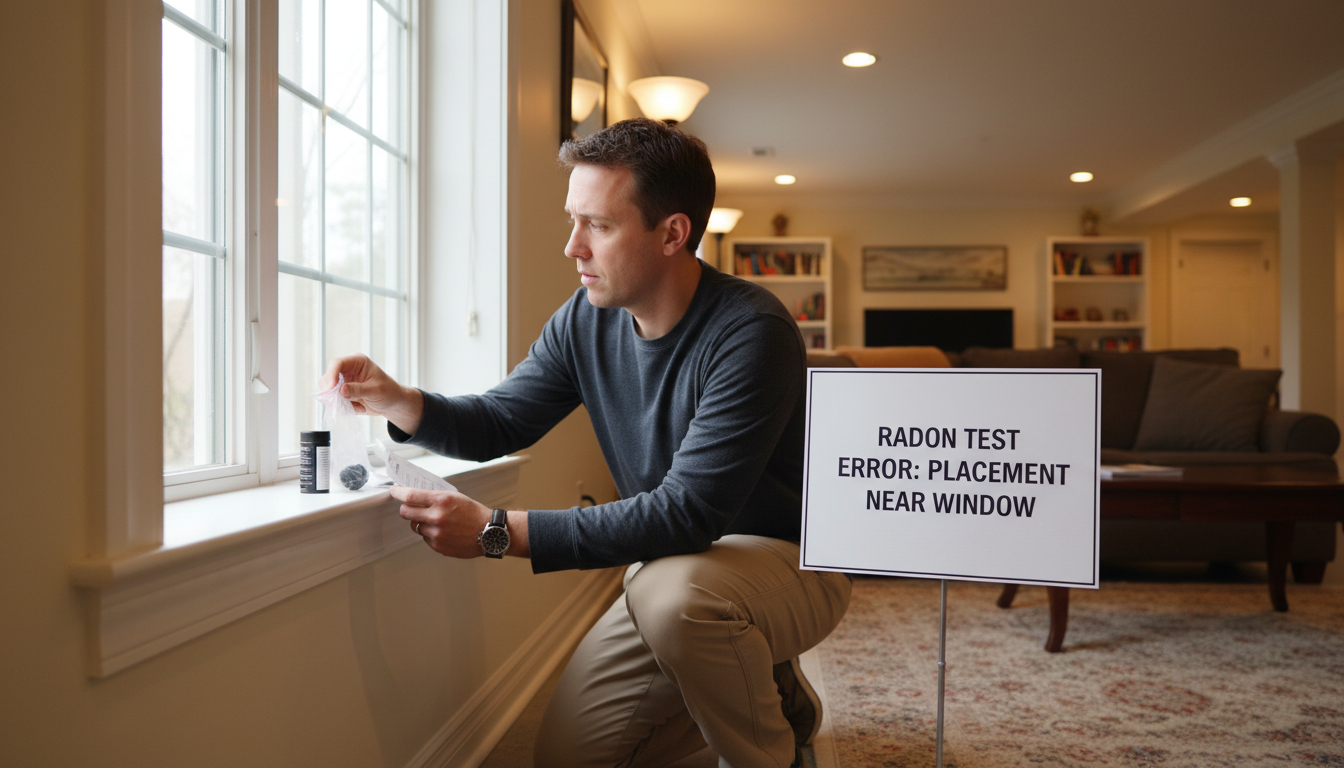
Radon is estimated to be linked with about 21,000 deaths each year in the U.S., yet many homeowners try quick DIY tests that quietly give them the wrong picture of their indoor air. If you are testing on your own, avoiding common radon testing mistakes is just as important as choosing the test kit itself.
1. Assuming One Test Answers Everything
Many DIY testers treat radon like a simple on-off problem: run a two-day kit and assume they are finished forever. In reality, radon levels drift with weather, seasons, and how you operate your home, so a single snapshot can give a false sense of security.
One national comparison study found that collocated short-term measurements could explain up to 79 percent of seasonal variation and up to 67 percent of annual variation when interpreted correctly. There is still a margin of uncertainty that DIY users often overlook.
If your quick test is near the 4.0 pCi/L action level, repeating it or switching to a long-term test is wise, especially in high-risk regions like Central Ohio.
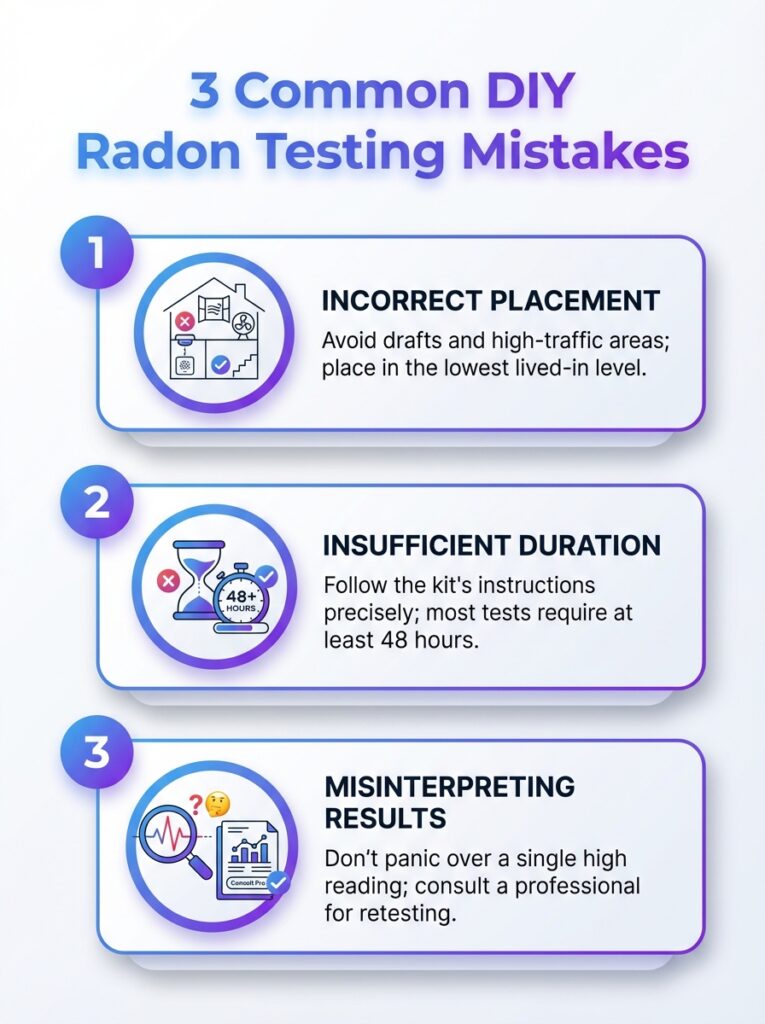
2. Placing the Test in the Wrong Location
Placement mistakes are one of the fastest ways to make a DIY radon test meaningless. Kits left on the floor, near a drafty window, or in a bathroom can show numbers that do not reflect what your family actually breathes.
For accurate results, you want a regularly occupied room on the lowest livable level, away from exterior doors, windows, vents, and direct sunlight. Avoid kitchens, bathrooms, and unfinished utility corners. Read our complete guide on where to place a radon test for step-by-step instructions.
We regularly see test canisters sitting on concrete basement floors or tucked into furnace rooms. Those tests often read unusually low or high, leading to poor decisions about whether mitigation is needed.
3. Ignoring EPA Closed-House Requirements
One of the most common DIY radon testing mistakes is running a short-term test with windows cracked open or fans pulling outdoor air through the home. EPA guidance is clear: short-term testing requires closed-house conditions.
For 2 to 7 day tests, EPA protocols call for keeping exterior doors and windows closed for 12 hours before starting the test and throughout the test period. You can open doors briefly for normal entry and exit, but major ventilation changes can distort readings.
If your DIY test was done while airing out the basement or with window fans running, it is worth repeating under proper conditions. Otherwise, you may underestimate radon and delay sensible mitigation.
4. Trusting Cheap Radon Gadgets Without Question
Online marketplaces are full of budget electronic radon monitors, and not all perform as their product pages suggest. Independent testing shows that conforming consumer-grade devices can keep short-term error under about 22 percent, while non-conforming units can drift from 28 percent up to 238 percent.
That kind of spread can change a 4.0 pCi/L reading into something that looks safe or dangerously high, even though the air has not changed. If you rely on a DIY device, choose one with third-party performance data and clear calibration guidance.
For a reliable alternative, check our guide on Ohio radon test kit accuracy to understand what to look for in a testing device.
5. Misreading Short-Term vs Long-Term Results
Another DIY mistake is assuming any short-term test equals a multi-month average. Research on test duration shows that one-week tests can be reasonably accurate in lower-risk regions, but high-radon areas may need three months of data to capture typical conditions.
If your home sits in a Zone 1 county or a local hot-spot neighborhood, use short-term tests as a first step, not a final verdict. Understanding short-term vs long-term testing helps you pair the right method with your situation.
6. Overlooking Local Radon Risk
Many homeowners start DIY testing because they hear a national statistic and get curious, but they never check how their county actually compares. Franklin County sits in EPA Radon Zone 1, where many homes exceed recommended levels.
In high-risk zones, assuming a single low DIY reading means "no problem" can be misleading. Weather shifts, home renovations, or foundation changes can alter pathways that radon uses to enter your living space.
The Columbus Dispatch tested 68 homes in our area and reported that a majority showed elevated readings, which underlines why periodic retesting makes sense even if your first DIY test looked fine. Winter testing is especially important since levels spike during cold months.
7. Using DIY Results Incorrectly in Home Sales
DIY kits often show up during real estate transactions when buyers or sellers want quick clarity. The problem comes when a single short-term test is used to over-promise a "radon-free" home or to ignore local norms around mitigation.
In Columbus, it is common to negotiate mitigation installation if a professional test shows levels at or above 4.0 pCi/L. When buyers rely on a rushed, poorly placed DIY test, they may miss the opportunity to address radon while the transaction is open, which can be more expensive later.
Professional tests come with calibration records and standardized reporting, which helps everyone involved make calm, informed decisions.
Bonus: Assuming DIY Testing Means DIY Mitigation
DIY radon testing is usually safe and straightforward when instructions are followed, but mitigation is a different level of complexity. Modern systems like active soil depressurization rely on carefully calculated suction, pipe sizing, and fan performance.
Typical mitigation systems in Columbus range from about $800 to $2,500 depending on foundation type, with crawl space encapsulation packages running from about $1,800 to $3,200 when moisture and access issues are involved.
Do Not Forget to Re-Test
Even careful DIY testers sometimes make a final mistake: never re-testing after major home changes or after a mitigation system goes in. Basement finishing, sump pump installation, new HVAC equipment, or sealing projects can change building pressures and radon entry patterns.
We recommend retesting every few years and after any significant structural project. If a fan fails or a discharge pipe becomes blocked over time, indoor levels can rise again without any visible sign. Contact us for professional testing and guidance.